

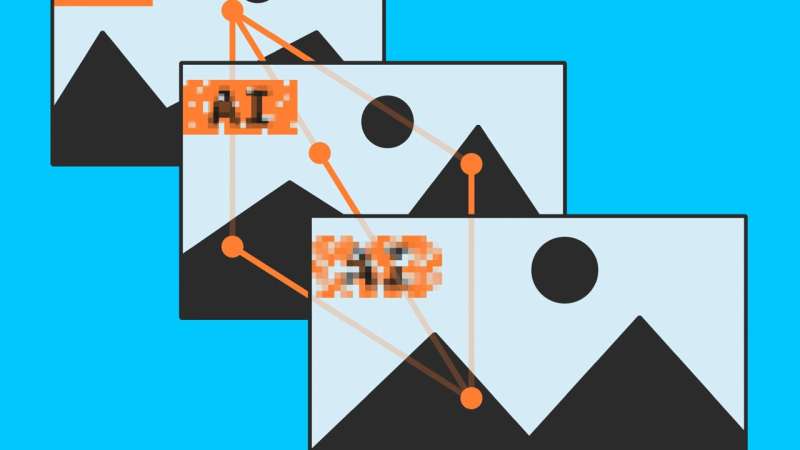
Researchers at CISPA have investigated whether watermarks embedded in AI-generated images can survive when those images are used to train another generative AI model. The findings suggest that some watermarks persist through multiple generations of models, while others quickly disappear, tells Tech Xplore.
Watermarks can place imperceptible signals inside AI-generated images, helping identify synthetic content and trace its origin. Their durability could become increasingly important as AI-generated images spread online and potentially enter datasets used to train future models. Repeatedly training models on synthetic data can contribute to model collapse, causing output quality to deteriorate.
CISPA researcher Michel Meintz and colleagues tested four watermarking techniques: TrustMark, StableSignature, TreeRing, and BitMark. They generated watermarked images, used those images to train another model, and then examined whether images produced by the second model retained detectable traces of the original watermark. Tests covered diffusion and autoregressive image-generation architectures.
Results varied considerably. Some watermark signals disappeared after a single training cycle, while others remained detectable much longer. BitMark performed particularly well. With the Infinity-2B model, researchers could reliably detect its watermark even when only 1% of the training dataset contained marked images.
The experiments also showed that watermark durability depends strongly on model architecture. A technique that survives one type of generative process may require modification to work effectively with another.
Practical challenges remain. Different AI providers use different watermarking systems, meaning one company may not recognize synthetic images marked by another provider. A shared watermarking standard could improve detection, but differing technical and commercial requirements make agreement difficult.
Meintz now plans to develop stronger watermarks that work across more architectures. A longer-term objective is detecting evidence of watermarked training data from a single generated image rather than analyzing an entire dataset.
