

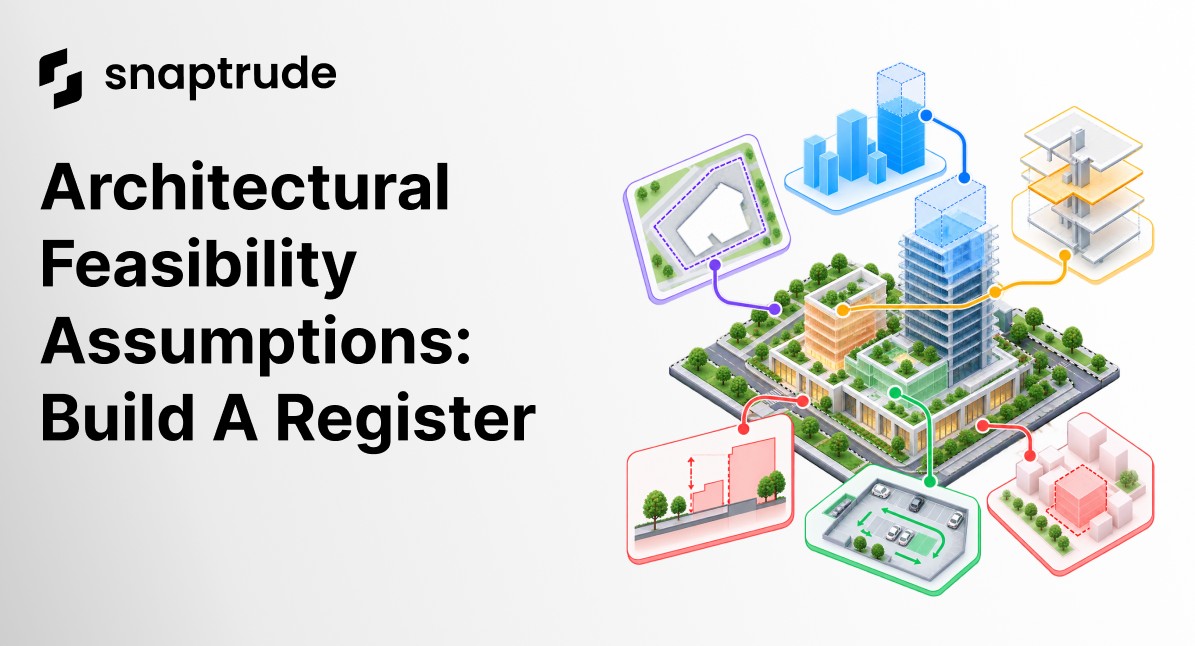
Architectural feasibility studies often begin before every project detail is confirmed. Snaptrude argues that teams should manage these uncertainties through an assumptions register that clearly records provisional inputs and their effects on design decisions.
Feasibility assumptions may include unconfirmed setbacks, estimated efficiency factors, working unit mixes, parking ratios, floor-to-floor heights, or preliminary structural grids. These assumptions differ from facts, targets, decisions, and risks. Keeping them separate prevents precise-looking models from giving uncertain information a false sense of authority.
A useful register should document each assumption’s source, confidence level, model expression, impact, sensitivity, owner, approval status, validation method, and expiry trigger. Teams should create the register before treating an early design option as a reliable result and update it whenever material decisions change.
Snaptrude recommends linking assumptions directly to model parameters, objects, formulas, or scenarios. Teams can then test credible alternatives to determine which assumptions materially affect yield, access, area, parking, cost, or other project outcomes. High-impact uncertainties should receive priority, particularly when they influence site boundaries, buildable envelopes, circulation, unit counts, planning requirements, or major cost commitments.
Sensitivity testing can classify outcomes as stable, sensitive, brittle, or unbounded. A stable option remains acceptable across plausible scenarios, while a brittle option can fail if one credible assumption changes. Unbounded uncertainty may require teams to pause a conclusion until better evidence becomes available.
Decision documents should highlight only assumptions capable of changing an outcome rather than overwhelming stakeholders with every provisional input.
Snaptrude’s connected program, design, BIM, and presentation tools can help teams locate and test these inputs. However, the article stresses that software cannot determine their authority. Project teams remain responsible for validating assumptions, assigning ownership, and preserving their decision history.
