

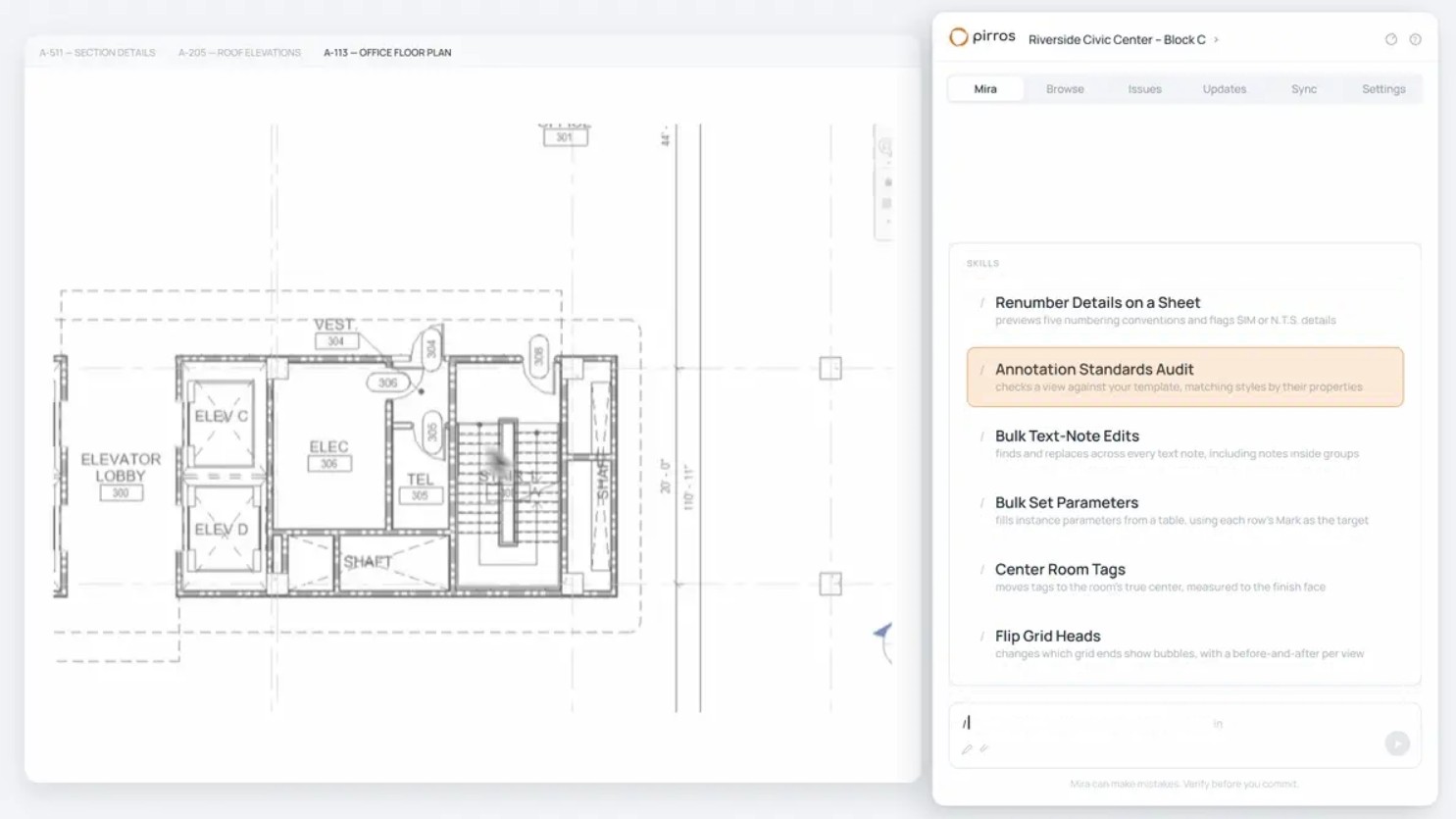
Pirros has added six skills to Mira, its AI agent for Revit, targeting documentation tasks that designers would otherwise perform one element at a time. Users can describe a task in natural language or select a skill from a menu, allowing Mira to apply changes across a sheet, view, or model.
The first skill automatically renumbers details on a sheet while considering existing numbering conventions. Mira previews proposed arrangements and flags details requiring special treatment. A second skill audits annotations against a firm’s template, matching line styles, text, and hatches by their properties rather than names.
Bulk text-note editing lets users replace product names or other repeated text across multiple views while preserving capitalization. The bulk parameter skill updates parameter values across many elements, converts units, and warns users when changing a type parameter could affect every instance.
Mira can also center room tags. Rather than moving only the visible tag, it adjusts both the tag and the room location point to the room’s calculated center. The sixth skill flips grid heads across selected grids and can repeat the arrangement in other plan views.
Each skill follows safeguards intended to keep users in control. Mira examines the model and presents its plan before making changes, requires confirmation, allows an entire batch to be undone in one step, and checks its work afterward. Ambiguous decisions return to the user rather than being guessed.
The update also enables Mira to break larger requests into multiple steps, extract information from PDFs, and automatically summarize earlier portions of long conversations. Firms can create custom skills for their own standards without coding.
Together, these additions shift Mira toward repeatable AI-assisted Revit workflows while preserving human review over model changes.
