

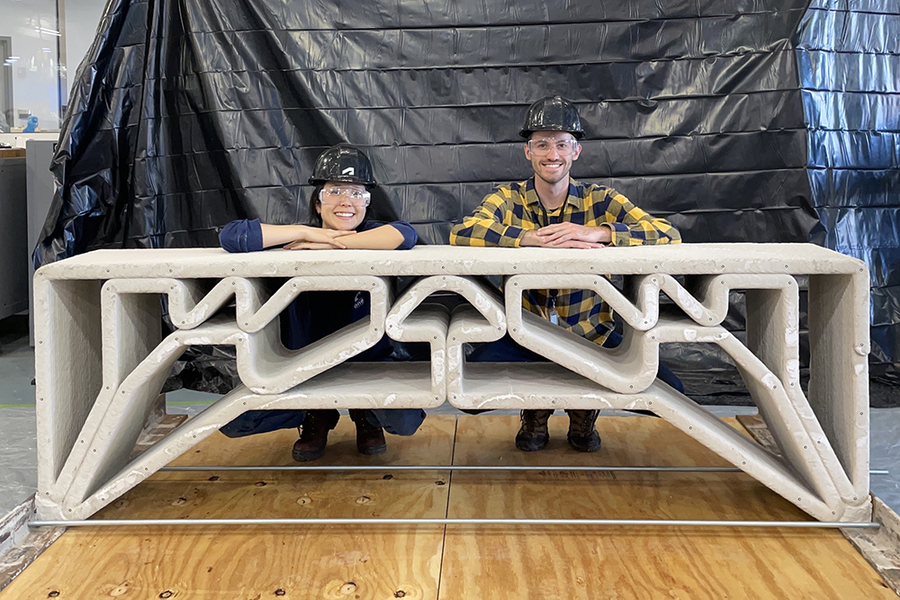
MIT researchers have developed a computational framework that could make 3D-printed concrete structures significantly more material-efficient while remaining practical to manufacture. The work addresses a long-standing mismatch between topology optimization, which produces mathematically ideal structures using the least possible material, and the physical limitations of large-scale concrete 3D printers. By incorporating printer constraints directly into the design process, the team demonstrated that optimized structures can be produced without sacrificing buildability, bringing sustainable construction a step closer to reality, tells MIT News.
The researchers tested their approach by designing and fabricating a 3D-printed concrete bridge. Unlike conventional topology optimization methods, which often generate intricate shapes that printers cannot reproduce, the new framework accounts for practical factors such as nozzle size, turning radius, and the need for continuous material deposition. Instead of modifying an optimized design after it is created, the system integrates these manufacturing constraints from the beginning, producing designs that printers can execute more reliably.
The study also explored how advances in printing hardware could unlock even greater environmental benefits. Simulations showed that a printer capable of depositing narrower, one-centimeter-wide beads instead of the current four-centimeter standard could reduce concrete consumption by as much as 76%. Because cement production is one of the largest industrial sources of carbon dioxide emissions, using substantially less concrete could significantly lower the environmental impact of bridges and other infrastructure while preserving structural performance.
Beyond the bridge demonstration, the framework could influence the design of buildings and other concrete structures that rely on additive manufacturing. By closing the gap between computational optimization and construction reality, the research enables engineers to create forms that are both efficient and manufacturable. The team believes future improvements in printer hardware, software, and materials could further expand these possibilities, allowing architects and engineers to reduce waste, lower embodied carbon, and make 3D concrete printing a more practical solution for sustainable construction.
