

Researchers have developed a cement-based supercapacitor that combines structural strength with energy storage, potentially allowing future buildings to store electricity directly within their concrete components. The technology could complement renewable energy systems by reducing reliance on separate batteries installed in utility rooms or on rooftops, tells Tech Xplore.
Supercapacitors store less energy than conventional batteries but can charge and discharge quickly and withstand large numbers of cycles. Researchers envision embedding them into buildings where renewable sources, such as solar panels, could recharge them frequently.
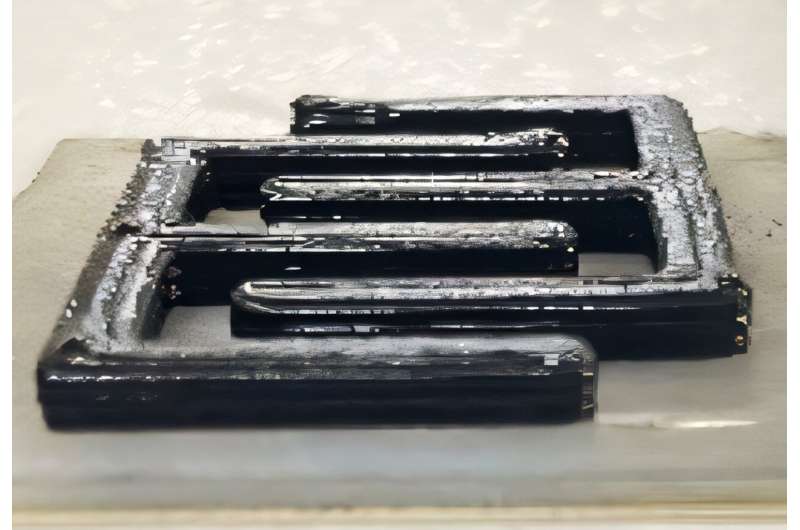
The team, including Jing Zhong, Wencai Ren, and Haiping Wu, created a printable electrode ink by combining cement, carbon nanotubes, and carbon black. Using a 3D printer, they deposited the mixture onto a small concrete slab in an interlocking finger pattern. As the cement hydrated, pores within the material filled with water and ions. The interdigitated electrode arrangement shortened the distance ions needed to travel, improving the device’s efficiency compared with earlier designs.
Importantly, adding energy-storage functionality did not eliminate the material’s structural usefulness. Compression tests showed that the cement-based supercapacitor achieved strength comparable to commercial concrete used for applications such as slabs and stairs.
To demonstrate its electrical capabilities, the researchers printed three supercapacitors on one concrete slab and connected them. Together, the devices successfully powered a small array of LEDs. Potential applications could eventually include emergency lighting and self-powered building sensors.
Temperature testing identified an important limitation. The supercapacitor remained stable under moderate heating and cooling, but its performance declined at approximately minus 18°C, or 0°F. The researchers plan to improve cold-weather performance in future work.
The study points toward multifunctional construction materials that do more than carry structural loads. By integrating energy storage into cement itself, buildings could potentially store locally generated renewable electricity while simultaneously supporting sensors and other smart-building systems.
