

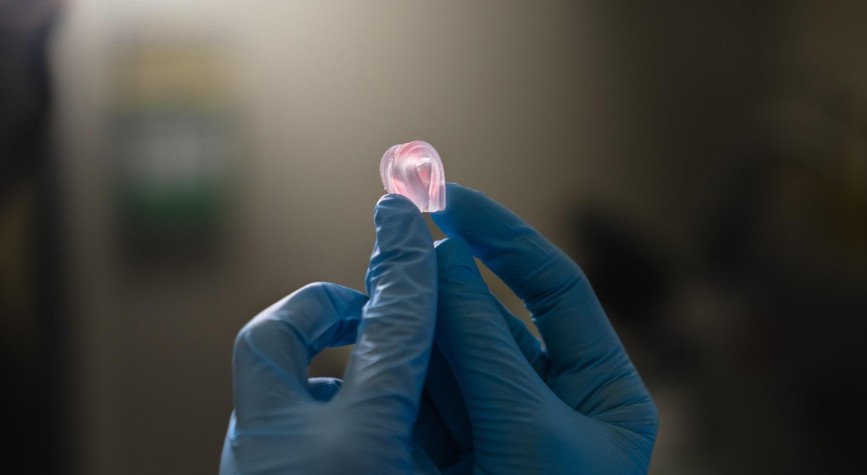
Researchers at the Swiss Federal Institute of Technology Lausanne, or EPFL, have developed a 3D-printable elastomer that combines high fracture toughness with strong fatigue resistance. This pairing is unusual because elastomers designed to resist sudden tearing often degrade under repeated stress, while fatigue-resistant materials can fail when overstretched or struck, tells 3D Printing Industry Blog.
The material, called a double network granular elastomer, consists of microscopic elastomer particles held together by a softer elastomer network. EPFL’s Soft Materials Laboratory first introduced the material in 2024 as an ink for printing structures with carefully controlled mechanical properties. Researchers later found that its granular architecture also allowed it to absorb energy repeatedly without permanent damage.
The two networks share mechanical strain. When the elastomer stretches, stress moves away from the rigid microparticles into softer surrounding regions. Polymer chains there can slide and rearrange instead of snapping, limiting irreversible damage. The granular structure also redirects cracks through winding paths between particles, slowing their growth. Tests showed fracture toughness up to 15 times higher than comparable elastomers and fatigue resistance up to three times greater.
The technology could support longer-lasting soft robots, flexible electronics, biomedical devices, wearables, and implants that experience repeated bending and deformation. Researchers are also exploring biodegradable elastomers and recycled feedstocks to reduce the material’s environmental impact and make it accessible to laboratories using commercial 3D printers.
However, the design still has limitations. DNGEs are softer than bulk double-network elastomers, and their low-damage behavior works mainly at moderate strains. Stronger stretching can break covalent bonds inside the stiff particles, while repeated cycling may produce heat. UV curing also limited test samples to about five millimeters in thickness. Thicker components will require another method for forming the second network.
Despite these constraints, the research shows that structural design can make printable soft materials tougher and more durable.
