

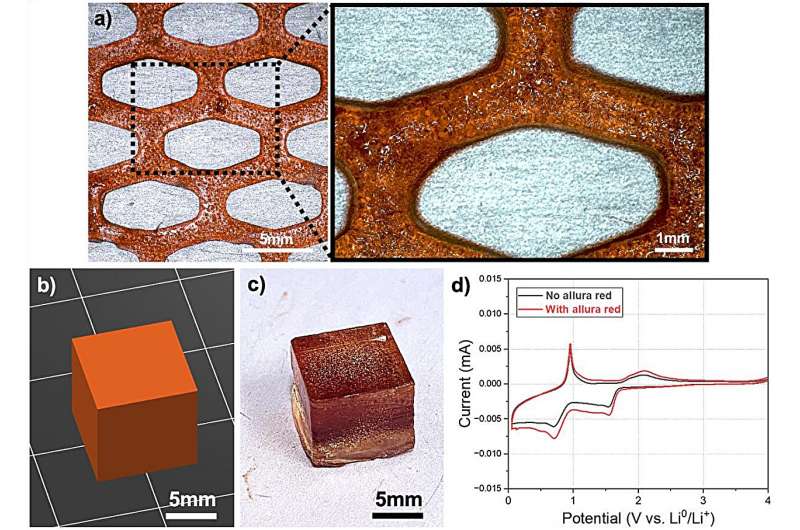
Researchers at the University of Texas at El Paso have developed a method to 3D print one of the most important components of a battery, the electrolyte, opening the door to rechargeable batteries that can be manufactured in virtually any shape. The breakthrough could free engineers from the long-standing constraint of designing products around standardized battery sizes, allowing energy storage systems to become an integrated part of the devices they power, tells Tech Xplore.
The electrolyte transports ions between a battery’s electrodes during charging and discharging, making it essential to battery performance. The research team created printable electrolyte formulations that can be fabricated into complex three-dimensional geometries while maintaining the ionic conductivity required for efficient energy storage. Using additive manufacturing, they successfully produced structures including discs, solid cubes, and open honeycomb lattices, demonstrating that the material can be customized to suit a wide variety of applications.
This design flexibility could have significant implications for consumer electronics, medical devices, electric vehicles, robotics, and aerospace systems. Instead of allocating space for a conventional rectangular battery pack, engineers could build batteries into unused cavities or structural components, improving space utilization while enabling more compact, lightweight, and innovative products. The approach also supports rapid prototyping and customized battery architectures that are difficult or impossible to manufacture using conventional production methods.
The researchers also evaluated the printed electrolytes for stability during repeated testing and identified one formulation that consistently delivered strong electrochemical performance. Their next objective is to integrate the electrolyte into complete battery cells to validate its performance in practical energy storage systems. If successful, the technology could expand beyond laboratory demonstrations to commercial applications requiring batteries tailored to specific products rather than standardized formats.
The work illustrates how additive manufacturing is reshaping battery engineering. By combining advanced materials with 3D printing, researchers are moving toward batteries that are not only safer and more adaptable but also designed alongside the products they power. As electronic devices continue to shrink while demanding greater performance, printable electrolytes could give engineers the freedom to rethink both battery architecture and product design from the ground up.
