

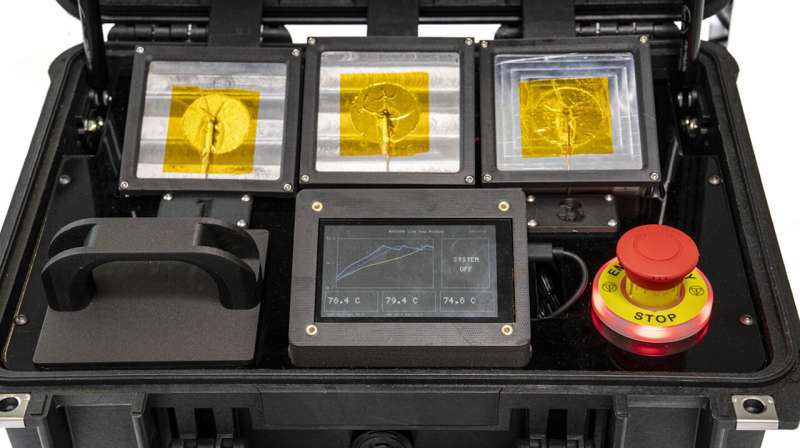
Engineers at the Johns Hopkins Applied Physics Laboratory, or APL, are developing a compact heatsink that combines additive manufacturing with phase-change materials to manage intense, short-duration heat loads. Called Smart Phase-change Enhanced Re-entry, or SPEAR, the technology targets electronics where conventional cooling is difficult because of strict size, weight, and power requirements, says Tech Xplore.
Phase-change materials absorb and store thermal energy as they transition from one physical state to another. In SPEAR, the material melts as it absorbs heat, limiting rapid temperature increases. The principle resembles ice melting in a drink, where energy goes into changing the ice’s state rather than immediately raising its temperature.
This thermal-storage capability could provide significant advantages over conventional metallic heatsinks. APL researchers say phase-change heatsinks can reduce size and weight by more than 50% while maintaining comparable thermal capacity. Potential applications include hypersonic vehicles, spacecraft, radio-frequency electronics, transmitters, interceptors, and other systems that generate substantial heat for relatively short periods.
Conventional phase-change heatsinks often require complicated assemblies made from multiple machined components. Advances in additive manufacturing allowed the APL team to instead produce single-piece heatsinks.
Researchers manufactured two SPEAR designs and compared them with a conventional aluminum heatsink. One had the same volume as the aluminum unit to demonstrate increased thermal-storage capacity. The second provided equivalent thermal capacity while demonstrating possible reductions in size and weight. Both phase-change heatsinks were successfully filled, sealed, and tested without leaks.
The team also built an integrated test system that simultaneously heats multiple heatsinks and displays their temperature responses in real time. Testing confirmed the anticipated thermal performance and size-and-weight advantages.
Because APL handled the design, 3D printing, hardware, software, packaging, and testing internally, engineers could quickly refine the concept. SPEAR demonstrates how additive manufacturing can move beyond geometric optimization by enabling thermal-management systems that would be more complicated to produce using conventional manufacturing.
