

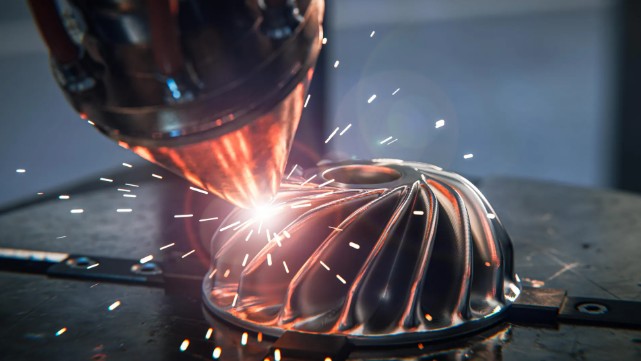
Tungsten carbide-cobalt (WC-Co) cemented carbide is one of the toughest engineering materials used in industry. Its exceptional hardness and wear resistance make it indispensable for cutting tools, drills, machining equipment, and construction applications. However, producing these components is expensive because tungsten and cobalt are costly raw materials, and conventional manufacturing often wastes a significant amount of material. Researchers have now demonstrated an additive manufacturing technique that could reduce waste and production costs while maintaining the material’s renowned mechanical properties, highlights Science Daily.
Traditionally, WC-Co components are produced using powder metallurgy, where tungsten carbide and cobalt powders are compressed and sintered at high temperatures to form dense, durable parts. Although effective, the process can consume more raw material than is ultimately incorporated into the finished product. To address this limitation, the researchers investigated hot-wire laser irradiation, an additive manufacturing technique that deposits material only where it is required.
The process combines a laser with a preheated filler wire, allowing material to be deposited efficiently while reducing the laser energy needed. Rather than completely melting the tungsten carbide, the method softens the material just enough for deposition. This is important because excessive melting can damage the carbide’s microstructure and reduce the hardness that makes it valuable for industrial applications.
The team evaluated two fabrication arrangements and found that both could produce high-quality cemented carbide. One method caused localized decomposition of tungsten carbide, while the other initially struggled to achieve sufficient hardness. By introducing a nickel alloy intermediate layer and carefully controlling the processing temperature, the researchers overcame these challenges and produced defect-free components with a hardness exceeding 1400 HV, comparable to conventionally manufactured WC-Co.
The study demonstrates that additive manufacturing can preserve the strength and durability of cemented carbide while using material more efficiently. Although further work is needed to minimize cracking, improve durability, and manufacture more complex geometries, the researchers believe the approach could eventually support large-scale production of cutting tools and other industrial components. The technique may also be extended to other difficult-to-process materials, offering manufacturers a more economical and sustainable way to produce high-performance engineering parts.
