

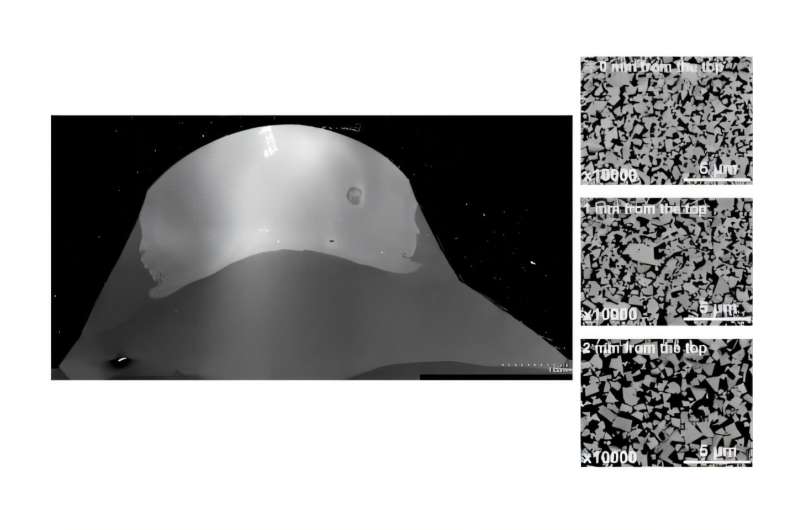
Researchers have made a significant advance in additive manufacturing by successfully 3D printing tungsten carbide–cobalt (WC–Co), one of the hardest engineering materials used in industry, says Tech Xplore. Cemented carbides such as WC–Co are prized for their extreme hardness and wear resistance, making them essential for cutting tools, drilling bits, and construction applications. Yet that same hardness makes them notoriously difficult and costly to shape using traditional manufacturing methods, which rely on powder metallurgy and high-pressure sintering. That process consumes large amounts of material, demands specialized equipment, and yields relatively low production efficiency.
The team’s work, published in the International Journal of Refractory Metals and Hard Materials, explored a new route using additive manufacturing (AM) combined with a hot-wire laser irradiation technique. In this method, a laser beam is paired with a preheated filler wire, a process sometimes called laser hot-wire welding, to increase deposition rates and material transfer efficiency. By integrating this approach with 3D printing, the researchers could deposit layers of WC–Co with minimal waste and maintain mechanical properties comparable to conventionally produced parts.
One of the challenges in processing cemented carbides through AM has been preserving the material’s hardness and structural integrity while building complex geometries layer by layer. The new technique addresses this by improving control over material placement and fusion, reducing defects that typically arise in laser-based fabrication. Importantly, the researchers found that parts produced using this approach retained the high wear resistance expected of WC–Co materials, making the process viable for real-world tooling and wear-resistant components.
This breakthrough suggests that additive manufacturing can extend beyond plastics and common metals into ultra-hard materials once considered unsuitable for 3D printing. Better efficiency and reduced waste could lower manufacturing costs and open doors for custom or low-volume industrial parts that benefit from tailored designs and the superior performance of cemented carbides. The work points toward a future where even the toughest engineering materials can be produced with the design freedom and sustainability advantages that AM offers.
