

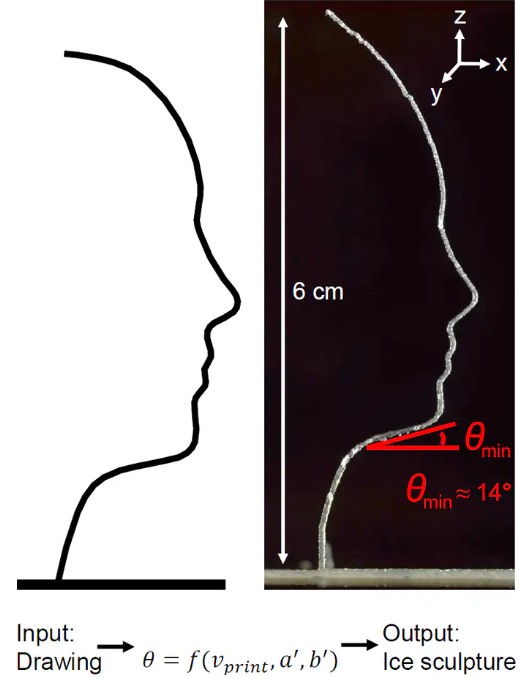
Physicists at the University of Amsterdam have developed a 3D-printing technique that creates complex structures from ice without requiring additional supports. The method, previously demonstrated by printing a miniature Christmas tree, can now produce angled pillars and nearly arbitrary profiles, broadening the possibilities for ice-based additive manufacturing.
The process relies on evaporative cooling, the same physical principle that cools the human body when sweat evaporates. Printing takes place inside a low-pressure vacuum chamber, where water evaporates rapidly even at room temperature. Each escaping water molecule carries away a small amount of heat, gradually cooling the remaining liquid below zero degrees Celsius while it stays in a supercooled state.
Researchers Menno Demmenie, Stefan Kooij, and Daniel Bonn direct an ultrathin stream of this supercooled water onto an existing layer of ice. The stream measures only 16 micrometers across, thinner than a human hair. When it touches the ice, the water freezes instantly.
The researchers found that varying the printer’s speed allows them to control the direction in which the ice grows. Using this approach, they printed pillars at different angles and created a human face profile with sections angled as little as 14 degrees relative to the surface.
Unlike conventional 3D printing, which often requires support structures beneath overhangs, the printed ice profiles are strong enough to support themselves. The process also produces little waste. Once the vacuum pump is turned off, the structures melt back into clean water.
Potential applications extend beyond experimental demonstrations. Pure ice structures could provide temporary scaffolds for growing biological tissue. In microfluidics, printed ice could create intricate channels that remain after melting. The researchers also suggest that Mars, with its cold temperatures and thin atmosphere, could provide suitable conditions for printing structures using locally available water.
