

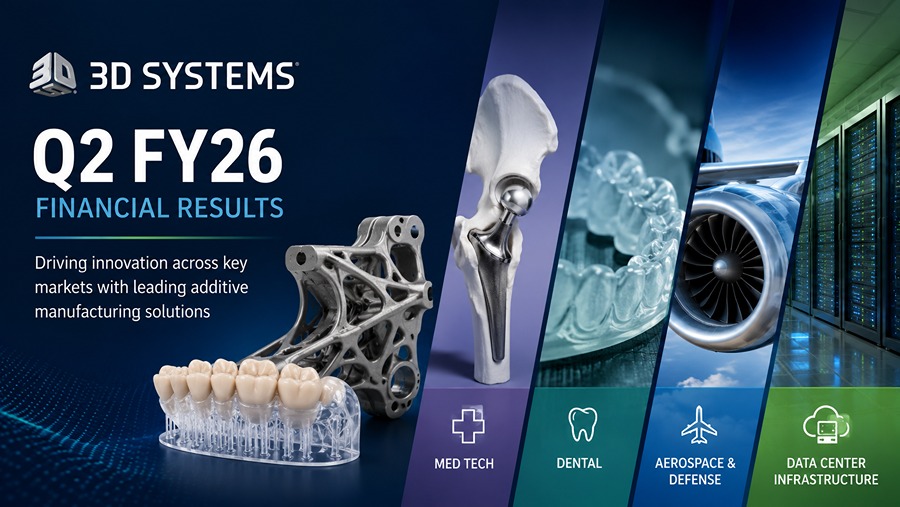
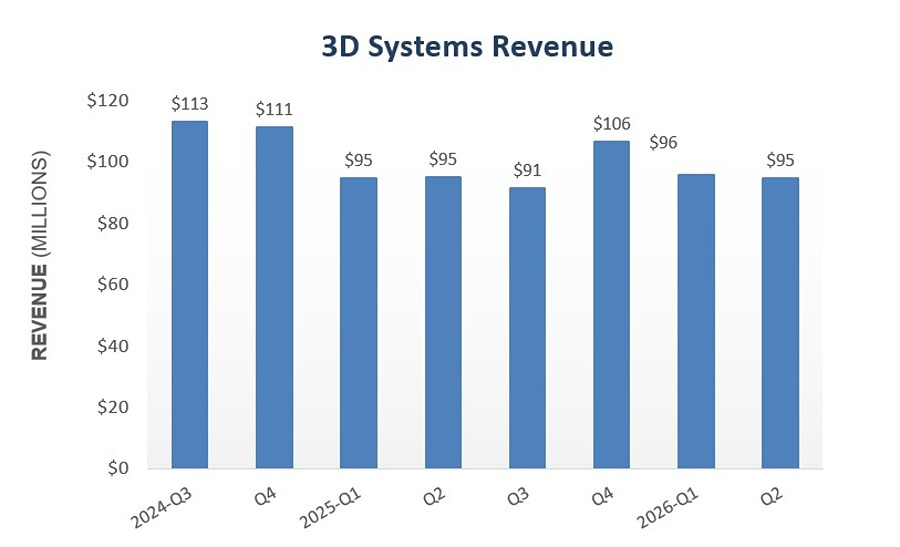
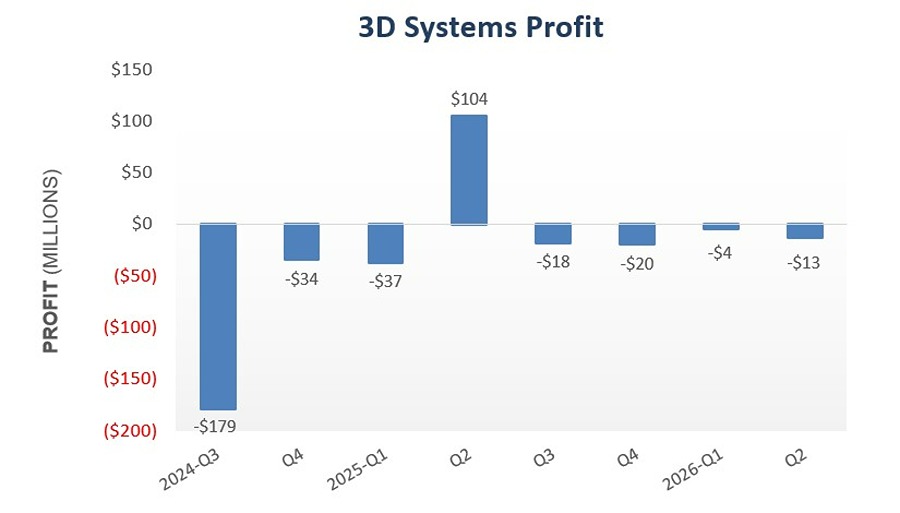
ROCK HILL, SC, Aug 4, 2026 – 3D Systems reported Q2 FY26 results, reporting $95M in revenue – a 0.9% decrease from $96M in Q1 FY26 – with a loss of $13M.
Second Quarter Financial Highlights
- Total revenue reached $94.6M, supported by growth in healthcare solutions.
- Healthcare Solutions revenue increased approximately 6.8% to $48.1M compared to the prior-year period.
- Operating expenses declined to $45.1M compared to $51.5M in the prior-year period, reflecting previous cost-reduction actions.
- Cash and cash equivalents totaled $128M as of June 30, 2026.
- Med tech, dental, aerospace & defense and data center infrastructure were key growth areas, while new metal and polymer printer sales increased at double-digit rates.
- Adjusted EBITDA improved to a loss of $0.8M from a $4.7M loss in the prior-year period.
Dr. Jeffrey Graves, president and chief executive officer of 3D Systems, said, “We are pleased with our second-quarter and first-half performance on both the top and bottom line. Revenue growth was driven by strength in our four key markets: Med tech and dental in healthcare, and aerospace & defense and data center infrastructure in industrial. Data Center Infrastructure is an emerging focus area for us and includes applications in chip manufacturing equipment and high-performance computing. Customers in these markets continue to adopt 3D printing as a core manufacturing technology and are expanding the range of applications they deploy. This performance highlights the market-leading breadth of our additive manufacturing portfolio, spanning direct metal printing and all five major polymer technologies, combined with our deep expertise in advanced applications. Of particular note is the growing impact of metal 3D printing, where design flexibility combined with cost-effective production is enabling higher-performance components and systems.”
Dr. Graves concluded, “As the additive manufacturing industry continues to emerge from a multi-year downturn, our sustained investments in research and development are now enabling us to introduce a broad portfolio of new products that are gaining increasing customer traction. While the global economic environment remains uncertain, we are optimistic that, as capital investment activity strengthens, we are well positioned to benefit from the resulting expansion in global manufacturing capacity.”
A detailed chart outlining the financial results is available here, providing a comprehensive breakdown of key metrics and performance indicators for better insight into the company’s financial standing.
Source: 3D Systems
About 3D Systems

3D Systems was founded in 1986 by Charles “Chuck” Hull, the inventor of stereolithography (SLA) and the first commercial 3D printer, the SLA-1. Based in Rock Hill, SC, the company has played a central role in the development of additive manufacturing technologies. Today, 3D Systems provides a range of 3D printing solutions that include hardware, software, and materials. Its offerings support a wide variety of industries – such as aerospace, automotive, healthcare, dental, and consumer goods – enabling workflows that range from early-stage prototyping to full-scale production. Its infrastructure spans offices, manufacturing facilities, and Customer Innovation Centers designed to support integration of 3D printing into industrial and commercial operations. Over the decades, 3D Systems has evolved from a technology originator into a solutions provider, focusing on application-specific capabilities across sectors including medical and dental, aerospace and defense, transportation, AI infrastructure, and industrial goods. Its engineering teams focus on improving manufacturing outcomes using additive technologies.
