

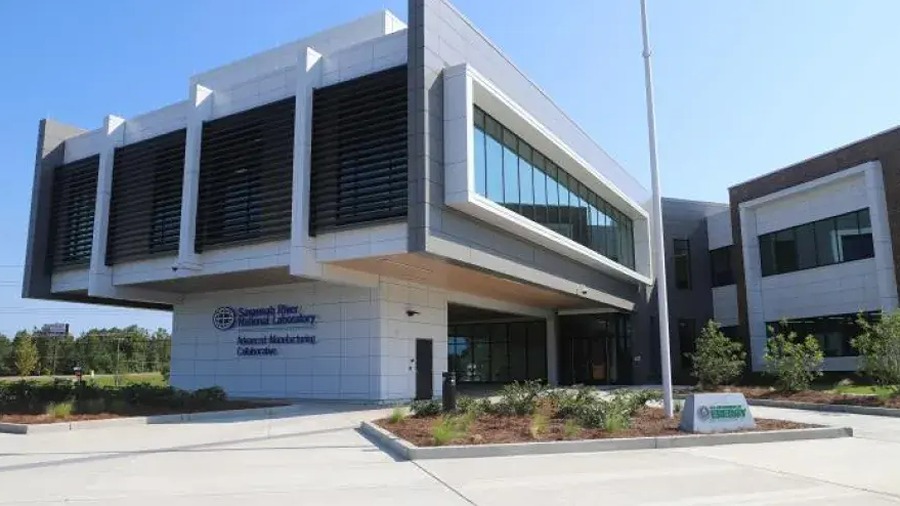
ROCK HILL, SC, Sep 1, 2026 – 3D Systems and Savannah River National Laboratory (SRNL) have signed a Cooperative Research and Development Agreement (CRADA) to develop additive manufacturing (AM) for energy generation and national security applications. The partnership is based at SRNL’s Advanced Manufacturing Collaborative (AMC) in South Carolina, the only national laboratory-operated site on a public university campus.
“We look forward to partnering with SRNL at the Advanced Manufacturing Collaborative and deploying 3D Systems’ leading AM technologies,” said Jeff Graves, president and CEO of 3D Systems. “This agreement demonstrates the impact and importance of high-quality 3D printing materials and technologies on key industrial markets, particularly energy and national security, and on developing the skilled workforce those markets require.”
Under CRADA, the two organizations will work on materials development, equipment enhancements, process optimization driven by AI/ML, manufacturing systems, cybersecurity and workforce development training.
Nuclear applications are a central focus of the agreement. AM can produce complex components from alloys that are difficult to fabricate with conventional methods, including nickel-based superalloys and radiation-tolerant materials. Target parts include heat exchangers with internal cooling channels, reactor internals, pumps and valves. The parts perform under extreme conditions with reduced material waste and greater design freedom.
The agreement comes as the U.S. nuclear sector sees renewed investment. The International Energy Agency projects small modular reactor (SMR) capacity could reach about 40 gigawatts under current policies, or up to 120 gigawatts in faster scenarios, by 2050. Demand drivers include data centers, industrial heat, grid stability and energy security.
“This collaboration positions SRNL and 3D Systems to deliver groundbreaking additive manufacturing technologies, strengthen U.S. manufacturing competitiveness, and drive forward the next era of AM innovation,” said Roderick Jackson, associate laboratory director for science, energy and innovation at SRNL.
3D Systems has installed equipment at the AMC, supported by facility upgrades. The CRADA is structured to move from foundational research to technology transfer and commercial application, to scale production solutions for nuclear energy, aerospace and defense, and environmental technologies.
“This agreement underscores SRNL’s commitment to building world-class research capabilities, leveraging partnerships to enhance its competitive edge and solidify its presence as a leader in AM technologies,” said G. Jeremy Leong, director of the AMC at SRNL.
The partnership also expands training for the next generation AM scientists, engineers and technicians, supporting the regional and national manufacturing workforce.
Source: 3D Systems
About Savannah River National Laboratory

Savannah River National Laboratory (SRNL) is a U.S. Department of Energy research and development laboratory based in Aiken, SC. Founded in 1951, it became a designated DOE national laboratory in 2004. Its research covers environmental management, national security, energy resilience, nuclear materials and waste processing. The laboratory also works on environmental remediation, advanced manufacturing, cybersecurity, modeling, simulation, hydrogen and fusion energy. Other research areas include materials science, geosciences, microbiology and atmospheric technologies. Customers and partners include DOE organizations, federal agencies, companies, universities and research institutions. SRNL also licenses technologies and provides technical services for government and commercial research programs. Battelle Savannah River Alliance operates the laboratory for DOE’s Office of Environmental Management. More than 1,400 employees and contract staff contribute to its work.
About 3D Systems

3D Systems was founded in 1986 by Charles “Chuck” Hull, the inventor of stereolithography (SLA) and the first commercial 3D printer, the SLA-1. Based in Rock Hill, SC, the company has played a central role in the development of additive manufacturing technologies. Today, 3D Systems provides a range of 3D printing solutions that include hardware, software, and materials. Its offerings support a wide variety of industries – such as aerospace, automotive, healthcare, dental, and consumer goods – enabling workflows that range from early-stage prototyping to full-scale production. Its infrastructure spans offices, manufacturing facilities, and Customer Innovation Centers designed to support integration of 3D printing into industrial and commercial operations. Over the decades, 3D Systems has evolved from a technology originator into a solutions provider, focusing on application-specific capabilities across sectors including medical and dental, aerospace and defense, transportation, AI infrastructure, and industrial goods. Its engineering teams focus on improving manufacturing outcomes using additive technologies.
