

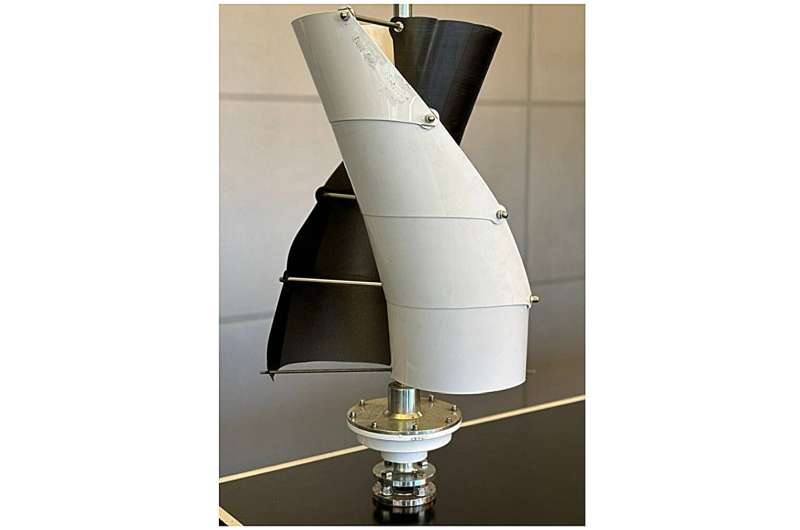
Researchers at Concordia University have developed a new 4D printing technique that could transform the way small vertical-axis wind turbine blades are manufactured. Instead of forming curved composite blades with expensive, custom-built molds, the new approach begins with flat carbon fiber composite panels that automatically reshape into the desired curved geometry. The innovation simplifies production while producing blades that are significantly lighter and more efficient than conventional aluminum designs.
The manufacturing process, known as 4D printing of composites, relies on carefully arranging the orientation of carbon fiber layers within a flat laminate. Once the composite is cured and released, internal stresses cause the material to bend into a predetermined three-dimensional shape without requiring complex forming equipment. By eliminating specialized molds, the technique reduces tooling costs, shortens manufacturing time, and offers greater flexibility when designing blades with different geometries.
To validate the concept, the researchers fabricated blades for a small vertical-axis wind turbine and compared their performance with commercially available aluminum blades. The composite blades weighed about 80% less while rotating faster during laboratory testing, indicating improved aerodynamic performance and lower rotational inertia. The lighter structures are also easier to transport, install, and handle, making them attractive for rooftop and urban wind energy applications where compact turbines are increasingly deployed.
Beyond improving turbine performance, the research demonstrates a practical application of advanced composite manufacturing. Because the method requires only a simple flat mold, manufacturers could produce a wide range of curved composite structures more economically than with conventional molding techniques. The researchers believe the approach could be adapted for other lightweight engineering components that require complex shapes, expanding its potential beyond renewable energy.
The work highlights the growing role of additive and smart manufacturing in sustainable engineering. By combining lightweight composite materials with programmable shape transformation, the new process reduces manufacturing complexity while improving structural performance. As demand grows for efficient distributed renewable energy systems, innovations such as 4D printed composite blades could help lower production costs, accelerate deployment, and improve the practicality of small wind turbines for buildings and urban environments.
