

Tunnels built through weak rock or subjected to high ground pressure can experience squeezing ground, in which surrounding material deforms inward and places increasing pressure on tunnel supports. Conventional supports can eventually crack or fail. Researchers at Saitama University and Taisei Corporation have now experimentally demonstrated how deformation-accommodating, or ductile, support systems respond to these demanding conditions, tells Tech Xplore.
These systems incorporate deformable materials called yielding elements into sections of the shotcrete lining. Instead of resisting all ground movement rigidly, the elements compress and allow the support to absorb some displacement. Previous studies examined yielding materials through compression tests, numerical simulations, and construction-site measurements, but limited experimental evidence existed on the behavior of an entire support structure.
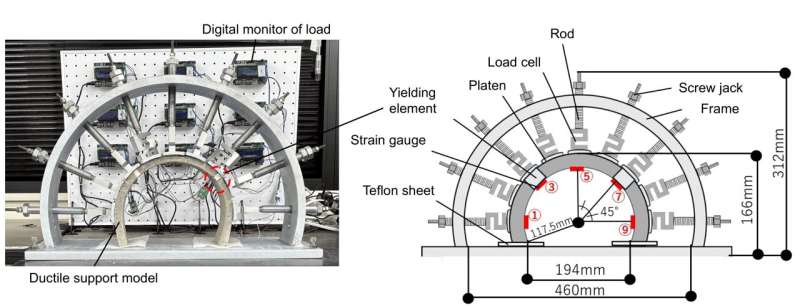
Led by Saitama University associate professor Yota Togashi, the researchers constructed 1/20-scale tunnel support models. Young-age mortar represented recently applied shotcrete, while ordinary Styrofoam simulated yielding elements. Nine independently controlled jacks applied isotropic compressive loads to reproduce squeezing-ground pressure.
The experiments showed that supports containing yielding elements accommodated greater displacement than mortar-only models. The elements absorbed movement primarily through compression around the tunnel circumference. Once they entered a region of rapidly increasing compressive deformation, deformation of the overall support also accelerated. Structural failure occurred after the yielding elements were almost completely compressed, although the maximum failure load remained comparable to the mortar-only model.
Placement also proved important. Nearly vertical yielding elements primarily accommodated vertical movement, while inclined elements enabled both horizontal and vertical displacement. A simplified beam-spring model successfully reproduced overall deformation patterns but requires refinement for more accurate stress predictions.
The researchers plan to conduct laboratory experiments with commercially available yielding elements. The findings could ultimately help engineers optimize tunnel supports for specific ground conditions, improving resilience in transportation, energy, urban development, and other underground infrastructure projects.