
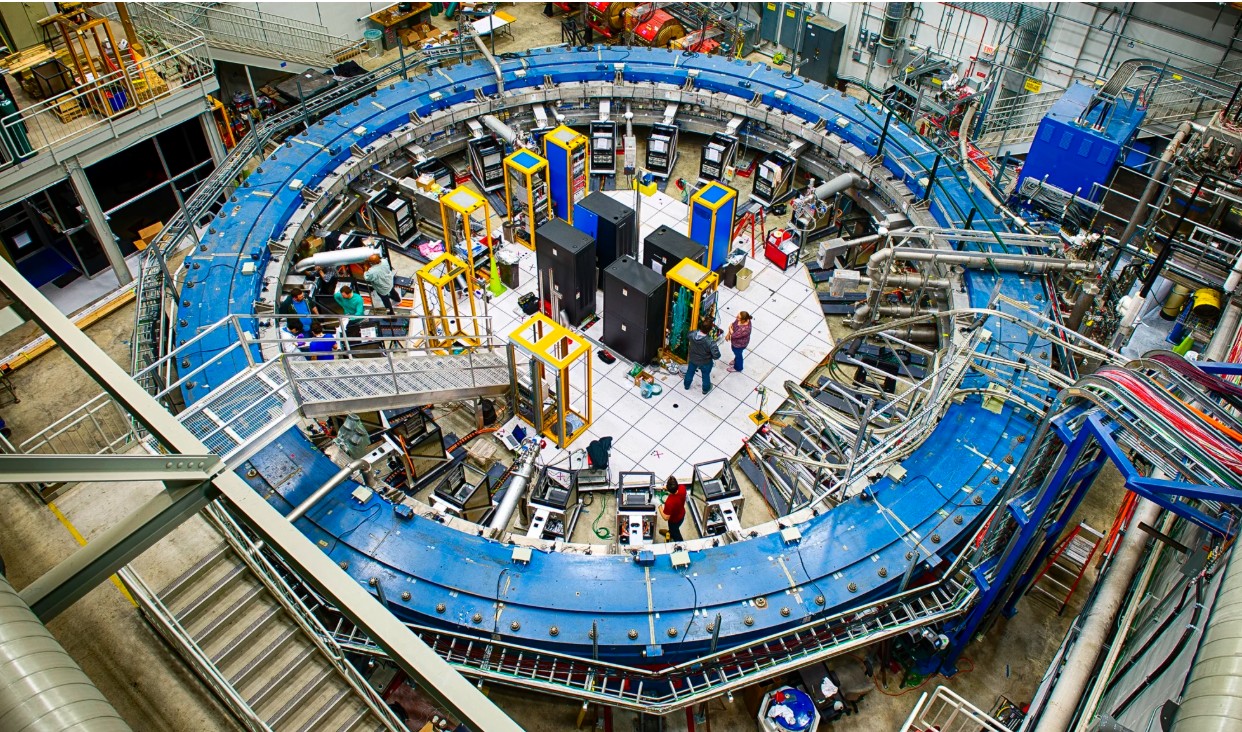
For 25 years, physicists have investigated a puzzling discrepancy involving the muon, a heavier cousin of the electron. Experiments suggested that muons wobble slightly more than predicted when moving through a magnetic field, raising hopes that unknown particles or forces might exist beyond established physics. New calculations have largely resolved that mystery, but they have exposed another unexplained conflict in particle physics, tells Quanta Magazine.
The key measurement is the muon’s g-2, which describes its tiny excess wobble. Quantum theory predicts that short-lived particles continually influence this motion. Calculating the contribution from the strong nuclear force, however, has been particularly difficult. One approach uses data from electron-positron collisions to estimate how strongly quarks affect muons. Calculations based on this data disagreed sharply with measurements from Fermilab, strengthening speculation about undiscovered particles.
A second approach, called lattice quantum chromodynamics, or lattice QCD, simulates quark interactions on computational grids. After years of advances in computing and simulation techniques, the BMW collaboration published a high-precision lattice calculation in 2021. Its prediction closely matched Fermilab’s measurements. Independent lattice groups have since reported compatible results, suggesting that known particles and forces can fully explain the muon’s behavior.
The apparent solution created a new problem. At Russia’s VEPP-2000 collider, updated measurements found a significantly different rate of pion production in electron-positron collisions compared with decades of earlier experiments. Recent lattice calculations and preliminary measurements from another VEPP-2000 detector support the newer rate. Yet earlier data from experiments such as BABAR agree with the older measurements.
Researchers must now determine whether experimental methods are causing the discrepancy or whether unknown particles are affecting quark interactions. The long-running muon mystery may be fading, but the conflicting pion measurements have opened another fundamental question about particle physics.
