

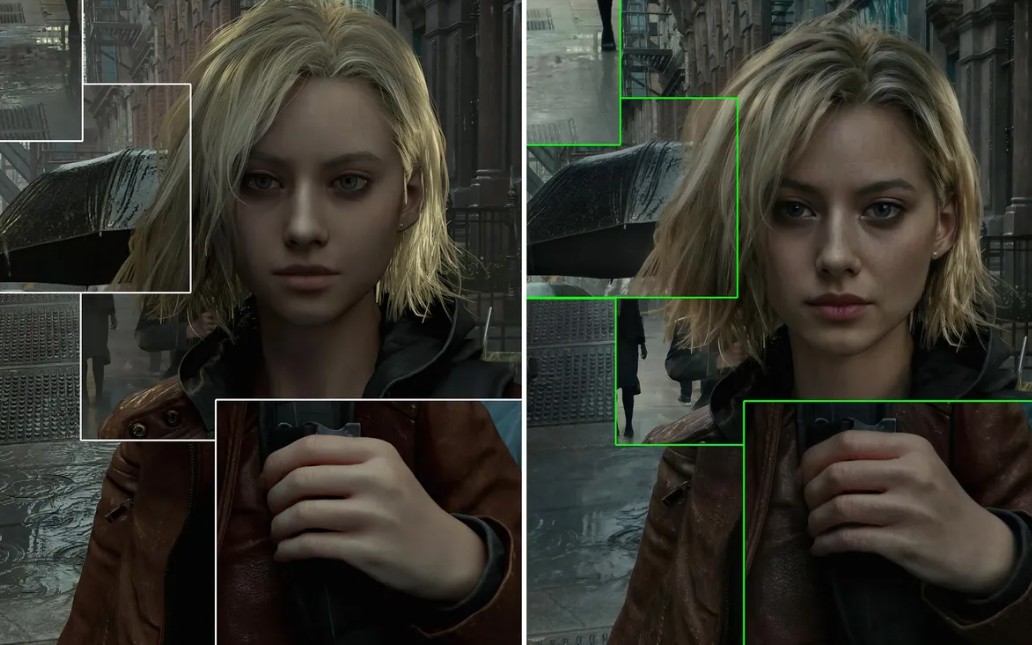
Nvidia is pushing computer graphics toward neural rendering with Deep Learning Super Sampling 5, or DLSS 5, a generative AI system designed to improve the appearance of video games in real time. Instead of relying entirely on GPUs to calculate lighting and material physics pixel by pixel, DLSS 5 uses AI to enhance the final rendered image, tells IEEE Spectrum.
Earlier DLSS versions focused largely on improving performance through upscaling and generating additional frames. DLSS 5 goes further by modifying individual pixels to produce more realistic lighting and materials. The system uses structured information from the game engine and analyzes characters, camera movement, lighting, and environments to maintain visual consistency from one frame to another.
Its neural model can reproduce complex effects such as light passing through hair and foliage, light scattering through skin, and tiny shadows across surfaces. Nvidia says these enhancements can be generated within milliseconds on a single GPU. Major publishers, including Bethesda, Capcom, Ubisoft, Tencent, NetEase, and Warner Bros. Games, plan to integrate the technology.
The approach comes with significant computing costs. DLSS 5 currently requires Nvidia’s GeForce RTX 50-series GPUs, and testing by Digital Foundry found performance reductions of 40–60% in NBA 2K27. Nvidia says optimization has already improved performance fivefold since its March 2026 preview.
Visual results have also sparked debate. Early demonstrations produced faces that some observers considered unnaturally polished. Artists have raised concerns that generative rendering could override carefully designed visual styles and make games look increasingly similar. Nvidia maintains that developers can control the technology, limiting changes to selected materials, objects, or lighting effects.
Despite these limitations, DLSS 5 points toward a broader shift in computer graphics. AMD and Intel already use AI for upscaling and frame generation, while future hardware across the industry is adding AI-focused processing. Neural rendering could eventually complement or even reshape the role of traditional real-time ray tracing.
