

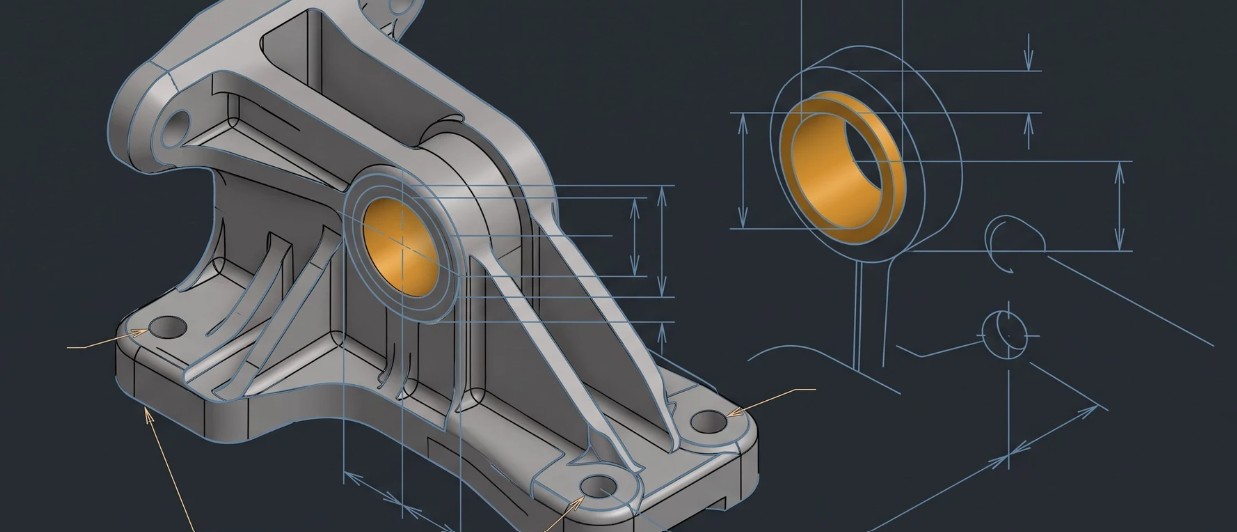
Engineering teams often have thousands of CAD files containing dimensions and other information that still requires someone to open a drawing or model manually. CAD drawing measurement APIs can automate this process, but extracting a trustworthy measurement is more complicated than simply reading a number from a file.
The Leo AI article identifies three types of information that APIs can retrieve. Metadata includes properties, configurations, revisions, and referenced components. Derived geometric quantities, such as volume, mass, surface area, center of mass, and distances, are calculated directly from solid geometry. Annotation data includes dimensions, tolerances, and callouts intentionally specified by engineers. This last category is often the most valuable and difficult to extract.
Problems arise because geometry, annotations, and property fields can contain different values. Geometry accurately represents the modeled shape but does not explain design intent. Annotations capture intent, yet manually overridden dimensions or graphical-only annotations can complicate automated extraction. Semantic annotations, including those supported by STEP AP242, provide structured information that software can query more reliably.
Access methods also vary. APIs for SolidWorks, Creo, and NX typically require licensed desktop applications, while standalone readers can retrieve limited metadata without opening CAD software. Cloud-native systems such as Onshape provide web-based access, while neutral STEP and IGES files can be analyzed using geometry kernels without a CAD license.
Two-dimensional drawings present additional challenges. View scales, manually overridden dimensions, scanned drawings, and graphical annotations can make automated measurement unreliable. More importantly, a CAD API cannot determine whether a file represents the latest approved design. Revision and release information usually resides in PDM or PLM systems.
The article argues that useful engineering retrieval therefore requires more than geometric access. Connecting CAD measurements with PDM and PLM context allows engineers to identify the correct file, verify its release status, retrieve measurements, and trace each answer back to its source.
