

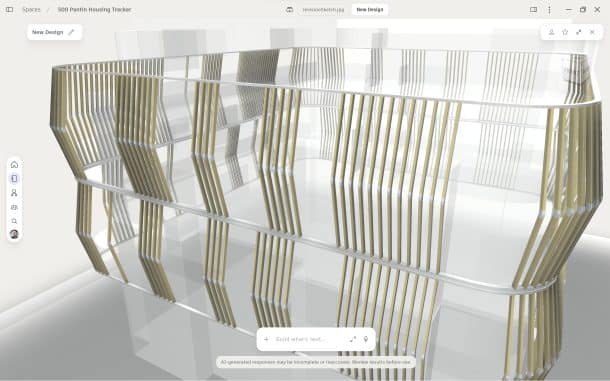
Autodesk is moving beyond application-specific AI chatbots toward an agentic ecosystem capable of coordinating work across design platforms, project data, and teams. At Autodesk University 2026, the company previewed a major evolution of Autodesk Assistant spanning its Forma, Fusion, and Flow industry clouds. The expanded standalone platform is expected to debut in 2027, tells Architosh.
Unlike the current Assistant, which primarily responds to prompts inside individual applications, the next generation is designed as a proactive orchestrator. Autodesk calls the resulting capability project intelligence, where AI can identify problems, coordinate specialized tools, and act across workflows rather than simply answer questions.
Three elements define the strategy. Personal Pulse will surface design issues, clashes, and anomalies that need attention. Assistant Spaces will provide shared environments where teams and AI agents can investigate problems and assess their impact. Assistant Builder will let organizations connect proprietary AI models, internal databases, and third-party tools. Developers could also distribute agents through a Design & Make Marketplace.
Behind these capabilities is Autodesk AI Orchestrator. Instead of relying on one large model for every task, the system selects specialized models according to accuracy, speed, security, and cost requirements. Autodesk’s cloud-based data architecture provides the foundation, allowing agents to work with geometry, physical constraints, manufacturing information, and historical CAD data.
Architosh argues that this grounding is crucial for professional design. General-purpose language models can hallucinate and struggle with spatial reasoning, while architecture and manufacturing require precise, physics-aware results. Autodesk aims to make AI-generated changes reviewable and capable of accounting for downstream effects involving fabrication, scheduling, costs, and sequencing.
The strategy remains largely a preview. Pricing, licensing, and regional availability are still unresolved, while privacy, security, and professional liability require attention. Still, Autodesk’s direction signals a shift from AI as an assistant inside software toward AI as an active layer coordinating design and engineering work across the project ecosystem.
