

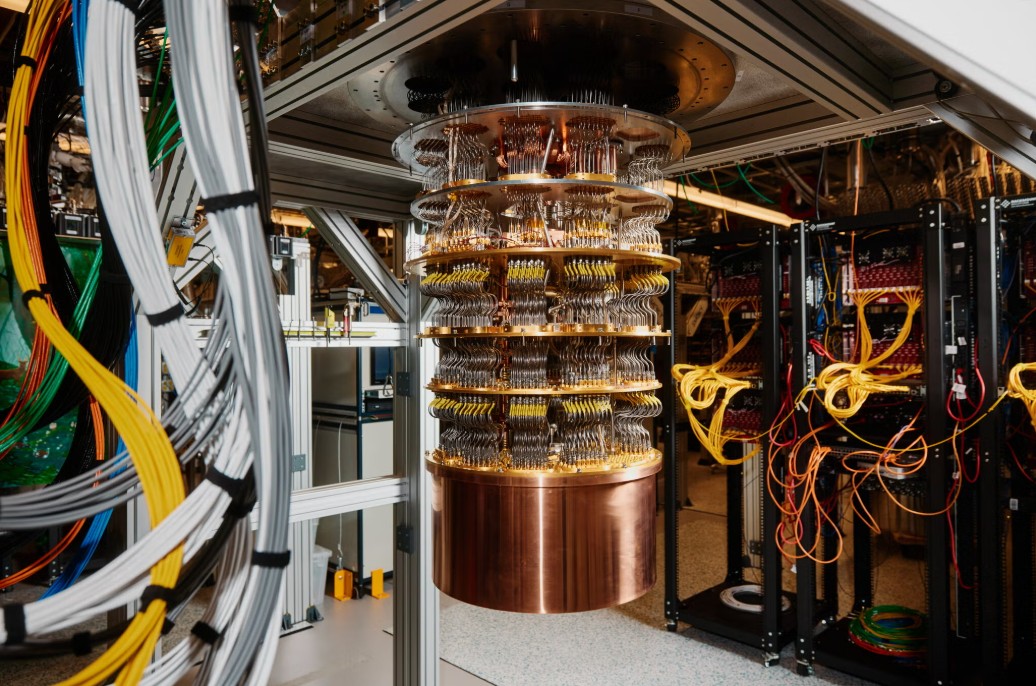
Researchers at Google have demonstrated a fundamental property of quantum mechanics that could enable quantum computers to perform calculations beyond the capabilities of classical machines. Published in the journal Science, the study examines quantum contextuality, a phenomenon in which measurement outcomes depend on the context of other measurements rather than predetermined values, tells The New York Times (full article available to subscribers).
Unlike classical computers, which store and retrieve information with fixed binary values, quantum computers process information through quantum bits, or qubits. Quantum contextuality challenges conventional assumptions about information by demonstrating that measurement outcomes cannot always be assigned independently of their measurement context.
Using Google’s experimental superconducting quantum computer in Santa Barbara, California, researchers demonstrated this phenomenon through a mathematical challenge known as the magic square game.
Similar to Sudoku, the game requires two participants to satisfy mathematical conditions within a three-by-three grid without communicating. By exploiting quantum contextuality, Google’s quantum computer achieved a higher success rate than the best possible classical strategy.
Although the mathematical exercise has no immediate practical application, it provides experimental evidence of a fundamental distinction between classical and quantum information processing.
Michel Devoret, a Nobel Prize-winning physicist and Google researcher, identifies contextuality as a powerful property of quantum mechanics. Harnessing this phenomenon could eventually enable quantum computers to tackle problems that remain computationally inaccessible to conventional supercomputers.
Potential applications include pharmaceutical discovery, materials development, artificial intelligence, and complex scientific simulations. However, translating experimental demonstrations into commercially useful computational capabilities remains a significant scientific and engineering challenge.
For engineers and technology professionals, the research offers valuable insights into the physical principles underlying quantum computing’s potential advantages. Rather than simply accelerating conventional calculations, quantum computers introduce fundamentally different approaches to information processing.
Google’s findings represent an important step toward understanding and exploiting these distinctive quantum properties, although substantial research and hardware development remain necessary before practical applications become widespread.
