

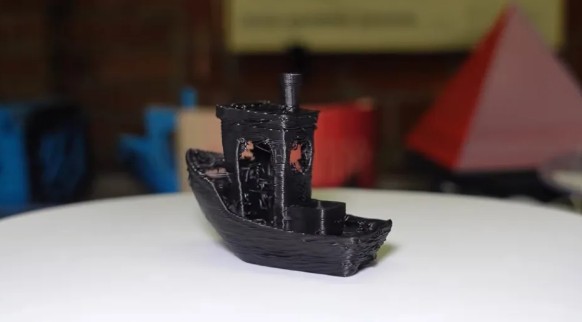
A 3D-printing enthusiast has broken the long-standing speed barrier for producing a complete 3DBenchy model, achieving a remarkable print time of just 59 seconds. The milestone, reported by Tom’s Hardware, was accomplished using a heavily modified Minuteman 3D printer equipped with a redesigned bed-motion system intended to reduce vibration and maintain stability at extreme speeds.
The 3DBenchy, a small boat-shaped benchmark model widely used throughout the 3D-printing community, serves as a standard test for measuring printer quality, accuracy, and speed. While fast printing has become a major competitive focus among hobbyists and manufacturers, maintaining structural integrity and dimensional precision at high speeds remains a significant challenge.
The record-setting printer reportedly relied on extensive hardware and software optimization. The redesigned motion platform minimized unwanted oscillations that typically appear when printer components move too rapidly. Combined with advanced firmware tuning, lightweight moving parts, and carefully calibrated extrusion settings, the machine was able to complete the benchmark in under a minute while still producing a recognizable and functional print.
The article notes that modern high-speed desktop printing increasingly depends on motion engineering rather than simply raising motor speeds. As printers accelerate more aggressively, controlling resonance, inertia, and thermal consistency becomes critical. Many recent experimental designs focus on reducing the mass of moving components and improving synchronization between motion systems and extrusion flow.
Although the achievement is largely aimed at enthusiasts, it also reflects broader advances in desktop additive manufacturing. Technologies once limited to industrial systems are steadily appearing in consumer and maker-oriented printers. Faster print speeds can shorten prototyping cycles, improve manufacturing flexibility, and make desktop fabrication more practical for small-batch production.
At the same time, the article suggests that speed records remain partly symbolic because extreme settings are not always suitable for everyday printing. Ultra-fast prints can sacrifice surface finish, layer consistency, and long-term mechanical reliability. Even so, the sub-minute Benchy demonstrates the growing sophistication of open-source engineering and the increasingly experimental culture surrounding high-performance desktop 3D printing.
