

Hardware FYI uses Andy Kong’s Chargerless wearable to challenge the assumption that consumer hardware requires a large team and budget. The newsletter notes that companies may employ 70–75 specialists to launch a product. Kong’s work suggests that architecture, outsourcing, and experimentation can let a smaller operation make progress.
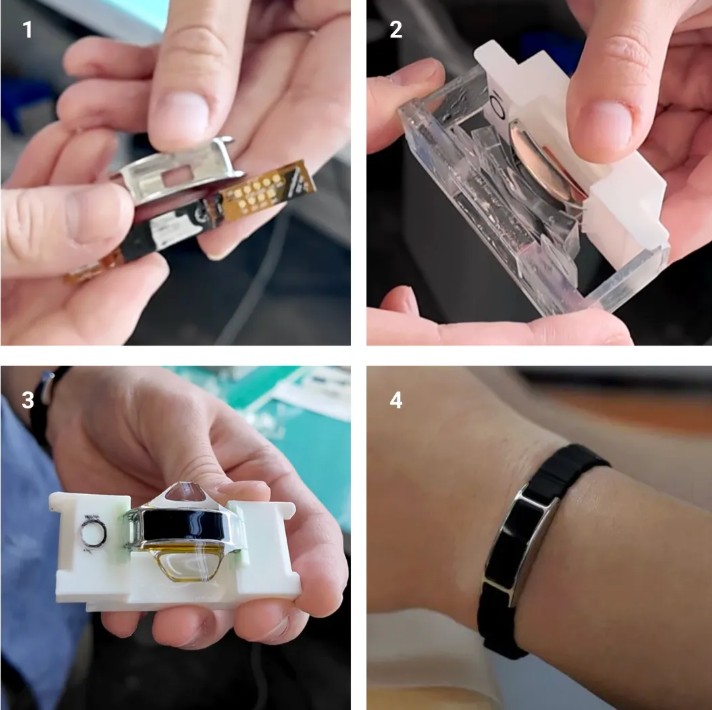
Chargerless is a health tracker designed to operate without charging. It averages about 7 microwatts of power and uses a battery smaller than 10 milliamp-hours. A silicon solar panel harvests light, while a flexible circuit board folds three times to fit inside its housing. Suppliers populate most of the board, but the solar panel and battery must be attached by hand. The assembly is waterproofed and placed in a machined case under optical epoxy, which allows light to reach the panel.
The example shows where a small team faces limits. Kong points to supplier relationships as an advantage for established wearable makers. Large orders can give a company access to custom components and influence over a manufacturer’s development plans. A founder working at lower volumes has less bargaining power and must design around what is available.
Kong uses AI agents to help develop firmware and app features, but connects their work to physical testing. Changes are checked against a device under test and a phone before reaching users. The approach recognizes that a language model can assist with bringing up a system yet struggle to diagnose problems on real hardware.
The newsletter broadens the issue with links on decoupling capacitors and engineering careers, a chart offering perspective on data center land use, and updates on recycling, satellites, wildfire technology, and power for AI facilities. Its central example is a reminder that resource constraints can push engineers toward simpler designs and faster learning, provided they test every idea against the product.
