

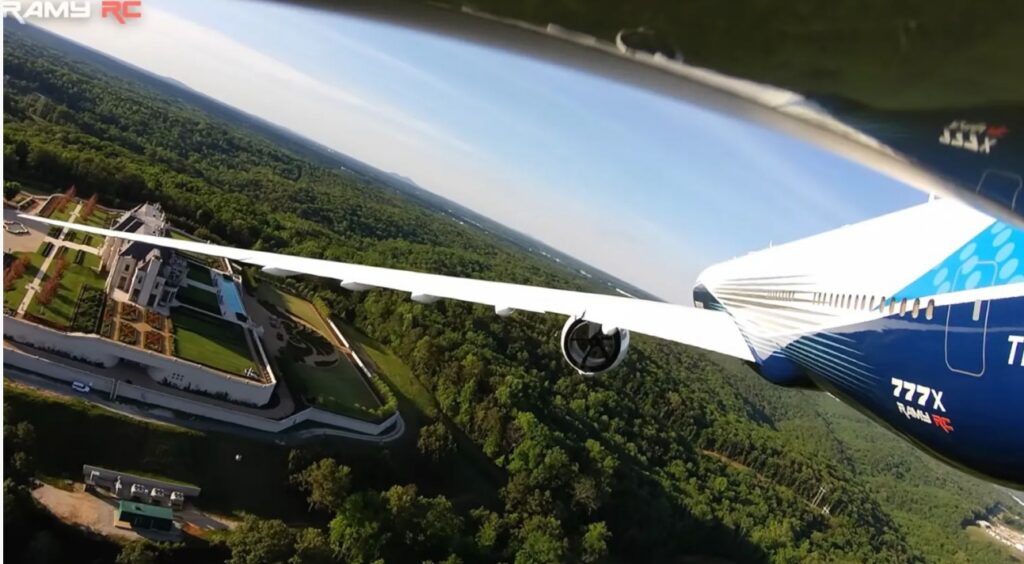
A team of aviation enthusiasts has successfully flown what is believed to be the world’s largest radio-controlled replica of the Boeing 777X, creating an engineering achievement that blends scale modeling, aerodynamics, and advanced remote-control technology. Featured by Popular Science, the project demonstrates the extraordinary lengths that dedicated builders will go to recreate modern aircraft with remarkable accuracy.
The aircraft is a massive scale model of the Boeing 777X, Boeing’s next-generation twin-engine passenger jet designed to succeed and expand the capabilities of the 777 family. Unlike typical hobby aircraft, the model spans several meters and incorporates many of the design features that distinguish the real aircraft, including its characteristic wing shape and overall proportions.
Building an aircraft of this size presented significant engineering challenges. The team had to carefully balance structural strength, weight, aerodynamic performance, and control responsiveness. Large radio-controlled aircraft experience forces that differ substantially from those affecting smaller hobby models, requiring detailed attention to materials, internal reinforcement, and flight-control systems. The builders employed lightweight composite materials and sophisticated electronic systems to ensure that the aircraft remained both durable and flyable.
One of the most impressive aspects of the project is its scale. The model is large enough to capture the visual presence of the full-size airliner while still being capable of safe remote operation. Its successful flights demonstrate not only craftsmanship but also a deep understanding of aircraft design principles. The project effectively serves as a flying engineering experiment, revealing how aerodynamic concepts used in commercial aviation can be adapted to scaled-down platforms.
The article highlights the growing sophistication of the radio-controlled aviation community, where advances in batteries, electric propulsion, composites, and digital flight-control technologies have enabled increasingly ambitious projects. What once would have been considered impractical is now achievable through a combination of modern engineering tools and enthusiast expertise.
Beyond its spectacle, the giant Boeing 777X replica reflects a broader fascination with aviation engineering. By recreating one of the world’s most advanced commercial aircraft in model form, the builders have demonstrated the enduring appeal of flight and the ingenuity required to transform a complex airliner into a functional radio-controlled machine.
