

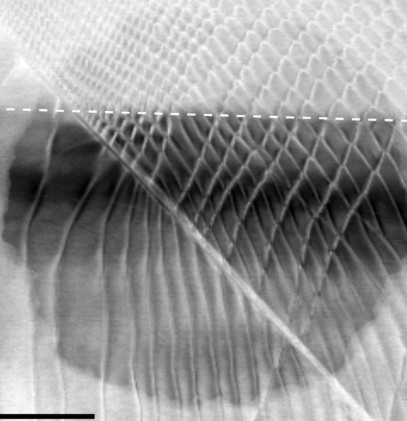
Researchers at Cornell University have developed a new method for creating moiré materials that does not require stacking and twisting separate two-dimensional layers. The breakthrough offers a simpler way to engineer the unusual electronic and quantum properties that have made moiré materials one of the most exciting areas of condensed matter physics.
Moiré materials are typically formed by placing atomically thin sheets on top of one another and rotating them at precise angles. This process creates large-scale interference patterns known as moiré superlattices, which can dramatically alter the behavior of electrons. These structures have enabled discoveries ranging from unconventional superconductivity to exotic quantum states. However, producing them requires meticulous fabrication and precise alignment of multiple layers.
The Cornell team found a way to generate moiré patterns within a single two-dimensional material rather than between separate layers. Instead of physically stacking sheets, the researchers engineered periodic distortions directly into the material’s atomic structure. These distortions created the same type of large-scale patterns and electronic effects normally associated with twisted multilayer systems.
The work demonstrates that moiré physics can emerge from carefully designed structural variations inside one material. This finding broadens the definition of what constitutes a moiré system and opens new opportunities for researchers seeking to manipulate quantum behavior. Because the approach avoids the complexities of assembling multiple layers, it could make the study and manufacture of moiré-based devices more practical and scalable.
Beyond simplifying fabrication, the technique provides scientists with greater flexibility in designing materials with tailored electronic properties. Researchers may be able to create custom quantum phases and investigate new physical phenomena by precisely controlling distortions at the atomic level.
The discovery represents a significant advance in the field of quantum materials. By showing that moiré effects can be achieved without stacking or twisting layers, the Cornell researchers have introduced a new platform for exploring electronic behavior and developing future technologies based on engineered quantum states.
