

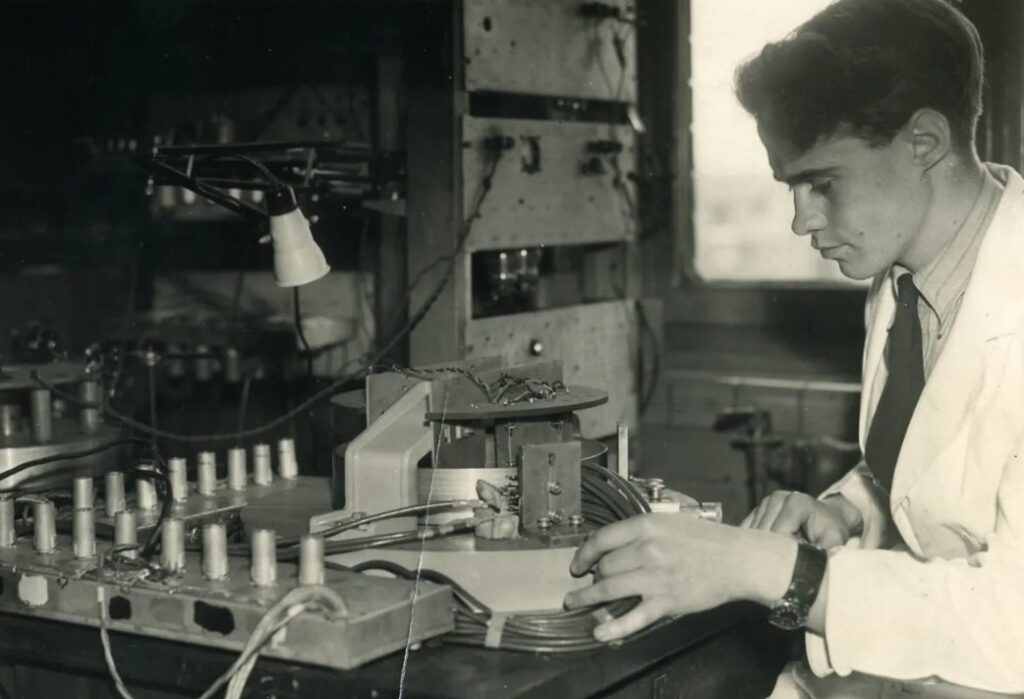
An article from IEEE Spectrum revisits the history and influence of Manchester code, a foundational digital encoding system that quietly shaped modern computing and communications. Recently recognized as an IEEE Milestone, the encoding method emerged from work at the University of Manchester in the late 1940s and became one of the most important techniques for transmitting reliable digital information.
Manchester code solved a major engineering problem facing early digital systems. In primitive computers and communication networks, electronic signals could drift out of synchronization, making it difficult for receivers to determine where one bit ended and another began. Instead of representing data through simple voltage levels alone, Manchester encoding embedded timing information directly into each bit by forcing a signal transition at the center of every data interval. This allowed receiving systems to maintain synchronization without needing separate clock signals.
The article explains that the method was closely associated with the Manchester Mark 1 computer and later spread across numerous digital communication technologies. By combining clocking and data into a single signal stream, Manchester code improved reliability in noisy or imperfect transmission environments. Although the approach sacrificed bandwidth efficiency compared to later encoding schemes, its robustness made it extremely attractive during the early decades of digital engineering.
Manchester encoding eventually became deeply embedded in technologies far beyond its original laboratory setting. The article notes its adoption in magnetic storage systems, RFID technologies, industrial communication systems, and especially Ethernet networking. Early Ethernet standards relied heavily on Manchester encoding because it offered dependable synchronization across shared network cables and varying hardware conditions.
The article also highlights the broader historical significance of the achievement. Many breakthroughs in computing history receive attention for processors, software, or user-facing inventions, yet low-level engineering innovations such as signal encoding quietly determine whether entire systems function reliably at scale. Manchester code represents one of those invisible but essential advances that helped move digital technology from fragile experimental machines into practical global infrastructure.
By recognizing Manchester code as an IEEE Milestone, the article argues, the engineering community acknowledges a deceptively simple invention whose influence continues to echo through modern communications and computing systems.
