

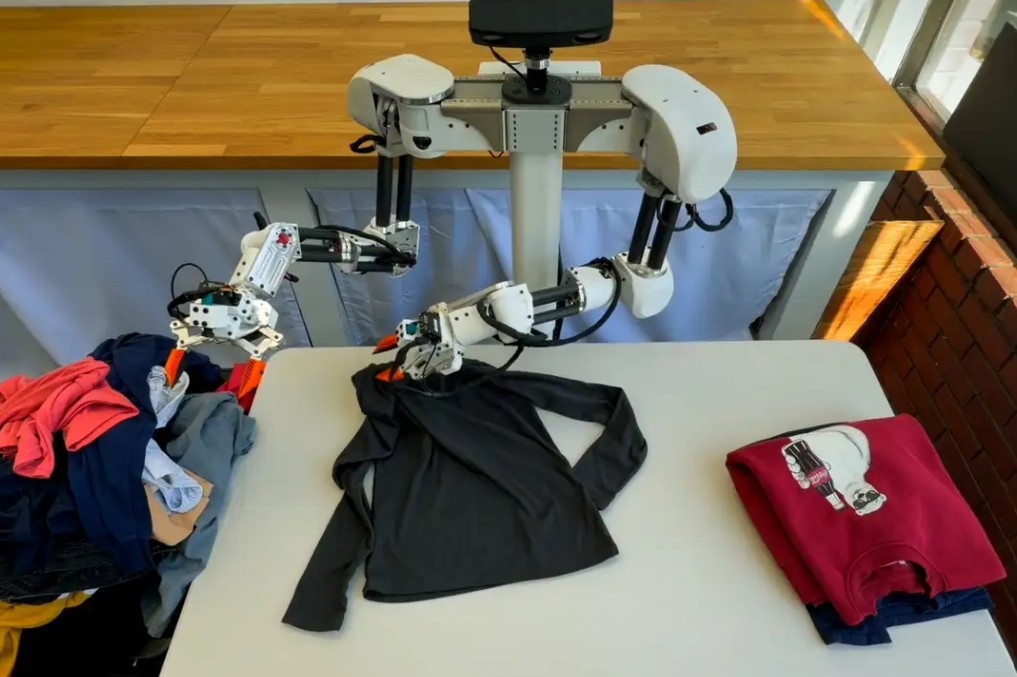
Physical Intelligence, a start-up founded in 2024, is pursuing an ambitious goal: creating a general-purpose robotic intelligence capable of controlling many different types of machines and performing a wide variety of tasks. Rather than designing robots for specific jobs, the company aims to develop a universal control system that can transfer knowledge across tasks and environments, bringing robots closer to becoming useful assistants in everyday life, tells this New Scientist article.
The company’s approach is inspired by the rapid progress of large language models (LLMs). Just as chatbots became dramatically more capable through advances in computing power, data, and algorithms, Physical Intelligence believes robotics can achieve a similar leap forward. Central to this effort are vision-language-action (VLA) models, which combine visual understanding, language processing, and physical actions. These systems use the broad knowledge of language models to translate human instructions into sequences of robotic movements, allowing a robot to tackle multiple tasks rather than mastering only one.
Training robots remains a significant challenge because the real world presents countless variations of even the simplest activities. Traditional robotics often requires extensive task-specific data collection and programming. Physical Intelligence hopes VLAs can reduce this burden by enabling robots to learn more efficiently from diverse experiences. To support this learning, the company operates simulated homes, kitchens, bedrooms, and supermarkets that are regularly reconfigured. Robots are also tested in real homes to expose them to unpredictable environments.
The strategy appears to be yielding promising results. One of the company’s recent models, called π0.7, successfully cooked sweet potatoes in an air fryer by following spoken instructions, despite having never encountered the appliance before. Such examples suggest that robots may be developing the ability to generalize beyond their training experiences.
Despite rapid progress, experts remain cautious. Researchers note that real-world deployment requires far greater reliability and adaptability than laboratory demonstrations. Human behavior, environmental complexity, and the enormous amount of data still required for training remain significant obstacles. While the vision of general-purpose robotic intelligence is becoming more plausible, many believe widespread commercial adoption remains years away.
