

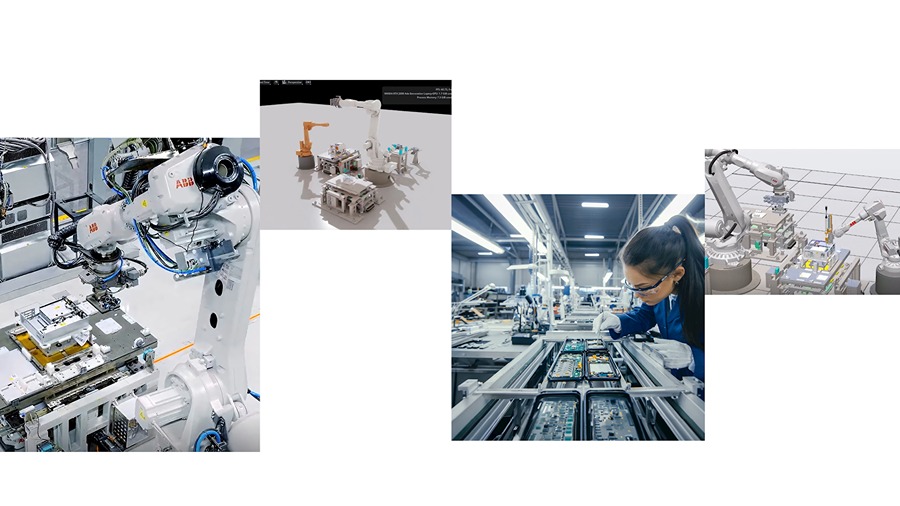
ZURICH, Switzerland, July 20, 2026 – ABB Robotics and NVIDIA have outlined a new approach for deploying industrial robots, published in a joint white paper. The methodology uses digital twins, synthetic data and AI validation to test robotic systems before physical deployment, a shift the companies say could speed up how manufacturers bring autonomous robots online.
“Through the leap forward in generative AI, we are moving from robots that execute predefined tasks to more Autonomous and Versatile Robotics (AVR) that can understand, adapt and learn in real time,” said Craig McDonnell, business line managing director, Industries at ABB Robotics. “Physical AI fundamentally changes what robots do, where they operate and the value they create. Closing the gap between robotic digital twins trained on synthetic data and their real robot counterparts is a breakthrough. Only by combining these hyper-realistic digital twins within a repeatable, industrialized engineering process can the full potential of Autonomous Versatile Robotics be achieved.”
“Physical AI is transforming how intelligent systems are developed and deployed in the physical world,” said Deepu Talla, vice president of robotics and edge AI at NVIDIA. “By combining simulation, synthetic data, accelerated computing and AI models, manufacturers can evaluate more scenarios, address edge cases earlier and accelerate innovation before deployment. The opportunity is not simply to build better models, but to create a continuous learning loop between the digital and physical worlds.”
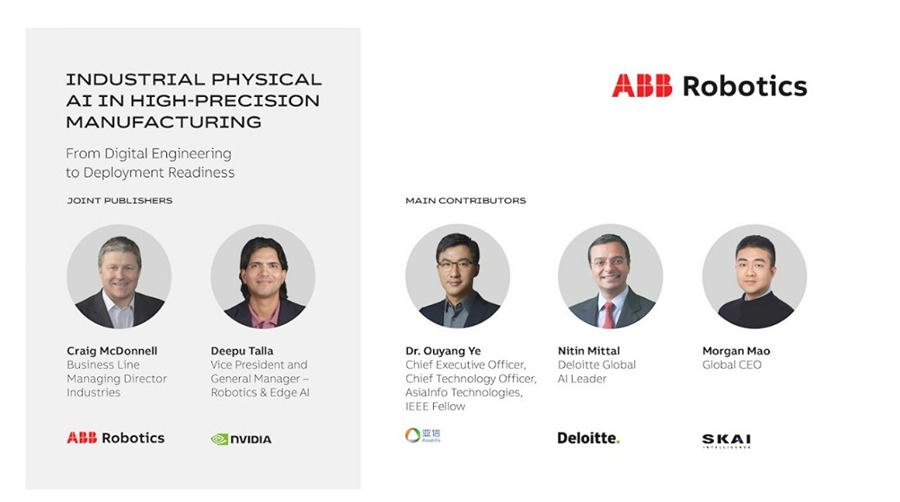
The paper describes a digital-first engineering approach that moves robotic vision risk assessment into the design phase, ahead of physical deployment. Manufacturers use digital twins, synthetic data and AI validation to test robotic systems before installing them on a factory floor, a process meant to surface issues earlier and produce engineering assets that are traceable, reusable and verifiable.
Once a system is deployed, operational data feeds back into the digital model, creating a closed loop for ongoing refinement. The paper also covers reference architectures, AI validation, robotic verification and feedback loops as components for scaling automation.
ABB Robotics is developing a Physical AI Toolchain built around this approach. The toolchain uses a learning workflow that combines simulated, synthetic data to train robots, rather than programming them. The toolchain runs on an open AI ecosystem, letting customers combine robotics engineering with data and AI models suited to their specific applications while maintaining industrial accuracy.
The white paper builds on a partnership between ABB Robotics and NVIDIA announced in March 2026. One product of that partnership is RobotStudio HyperReality, which combines ABB’s RobotStudio offline programming and simulation software with NVIDIA Omniverse libraries. The combination closes the gap between simulated and real-world robot performance, letting manufacturers design, test and deploy physical AI-powered robotic applications.
RobotStudio HyperReality has completed trials with select customers and will be available in the second half of 2026.
Source: ABB
About ABB Robotics

ABB Robotics is a business unit of ABB Ltd. that develops industrial and collaborative robots for automation. It produces robotic arms, autonomous mobile robots, controllers, and software for manufacturing and logistics operations. The division supplies systems for assembly, welding, material handling, inspection, and packaging tasks. It serves automotive, electronics, logistics, food and beverage, and general manufacturing industries. ABB Robotics traces its origins to ABB’s formation in 1988. ABB Robotics has deployed more than 500,000 robotic systems worldwide. Customers include manufacturers, system integrators, and logistics operators. ABB employs about 110,000 people globally across all business units.
