

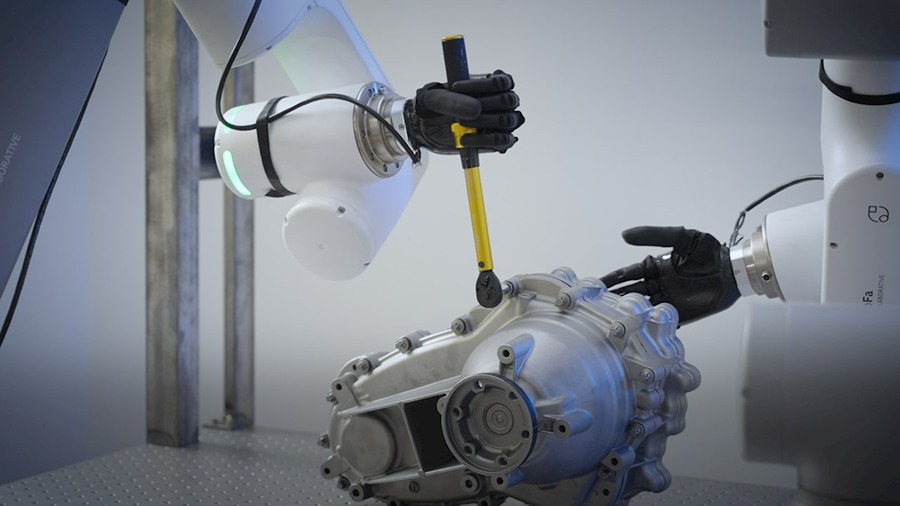
ZURICH, Switzerland, June 17, 2026 – ABB Robotics and PSYONIC are testing whether manipulation data from prosthetic hand users can improve robot grip control and dexterity. The work pairs the PSYONIC Ability Hand with an ABB GoFa cobot to study how touch and motion data from prosthetic use can train robots to handle delicate, variable tasks that remain difficult to automate.
“Human dexterity and the instinctive understanding of how to handle different objects is one of the most difficult things to replicate in industrial-grade robotics, but it’s a fundamental need for truly autonomous and versatile robots,” said Marc Segura, president, ABB Robotics. “As we develop the next generation physical AI, robots will learn and understand the world as we do. This collaboration with PSYONIC will help to close the long-standing gap between human and robot dexterity, opening up new possibilities for a wide range of industries.”
Grasping and dexterity are central to Autonomous Versatile Robotics (AVR) – ABB Robotics’ vision for robots that can sense, reason, move and handle objects in dynamic environments. They are also part of physical AI, where robotic systems learn from real-world interaction and apply that learning to industrial tasks. The companies will examine applications in automotive, aerospace, packaging and logistics, and life sciences, including repetitive, ergonomically difficult tasks and processes that are hard to perform consistently. PSYONIC is working with ABB Robotics’ R&D team on integration and development, with a focus on touch-enabled manipulation for robotics applications.
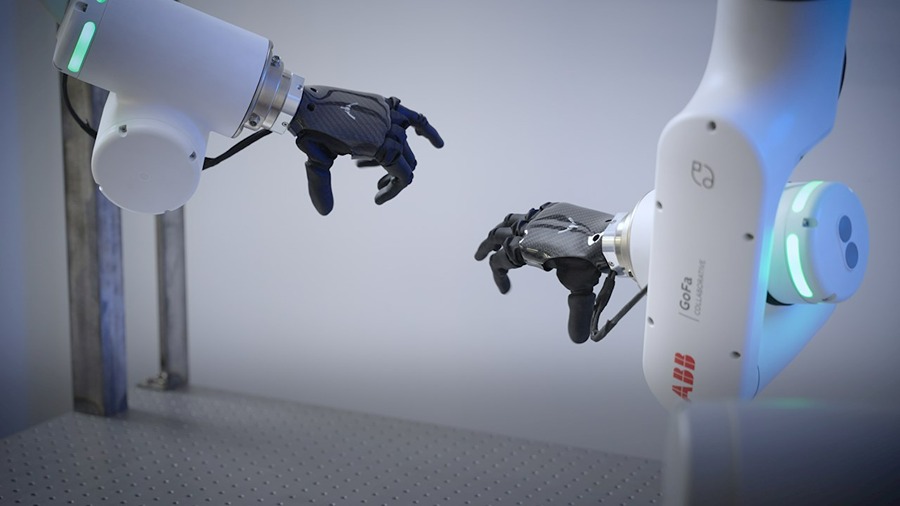
Robotic Dexterity with Human-Generated Data
The PSYONIC Ability Hand combines myoelectric control, touch sensing and compliant mechanics in a lightweight design. Its pressure sensors and vibration feedback system allow users to detect contact, grip force and release, while flexible fingers conform to irregular and deformable objects.
“Dexterous manipulation is ultimately a data challenge as much as a hardware challenge,” said Dr. Aadeel Akhtar, founder and CEO of PSYONIC. “By using the same Ability Hand on people and on robots, we can capture high-fidelity real-world data on movement, contact and grip force, then use that to train robotic systems more effectively. Integrating with ABB Robotics’ robotics platform allows us to expand into more environments and unlock the level of dexterity needed to take on the hardest challenges in automation.”
ABB Robotics’ GoFa provides the accuracy and repeatability needed for industrial-grade deployment. The system will execute and evaluate small variations in grip force, finger positioning and movement. That precision is needed to translate human-derived manipulation data into robotic performance across variable tasks.
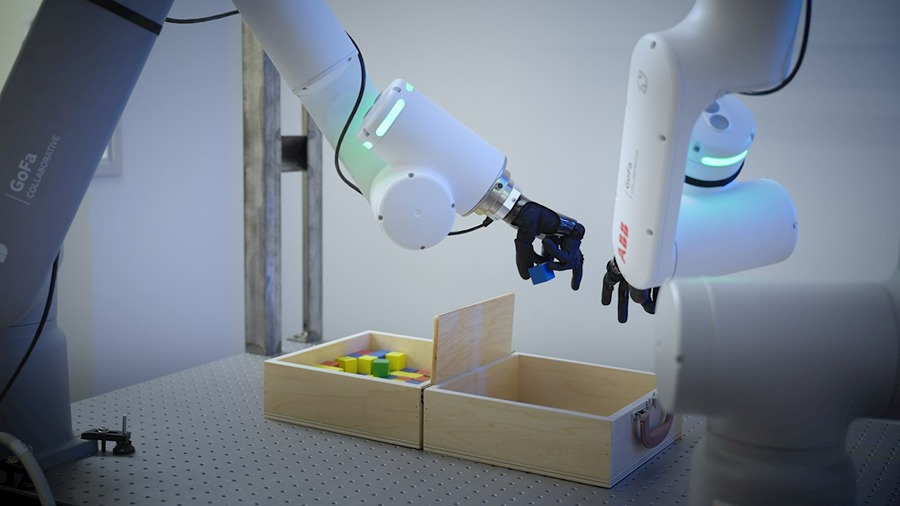
The collaboration will assess how the system can be used in industrial settings where traditional gripping technologies struggle with variability, fragility or complexity, such as handling irregular or delicate objects. According to the International Federation of Robotics, advanced gripping and digital integration can reduce engineering time by up to 30%, underscoring the role of end-of-arm tooling in deployment speed and automation ROI.
The work also reflects ABB Robotics’ partner-based approach to addressing automation barriers. By combining robotics, AI and manipulation data generated through human prosthetic use, ABB Robotics aims to develop physical AI systems that can operate in industrial environments.
Source: ABB Robotics
About ABB Robotics

ABB Robotics is a business unit of ABB Ltd. that develops industrial and collaborative robots for automation. It produces robotic arms, autonomous mobile robots, controllers, and software for manufacturing and logistics operations. The division supplies systems for assembly, welding, material handling, inspection, and packaging tasks. It serves automotive, electronics, logistics, food and beverage, and general manufacturing industries. ABB Robotics traces its origins to ABB’s formation in 1988. ABB Robotics has deployed more than 500,000 robotic systems worldwide. Customers include manufacturers, system integrators, and logistics operators. ABB employs about 110,000 people globally across all business units.
About PSYONIC

PSYONIC develops bionic prosthetic devices and robotic technologies for healthcare and research uses. Its main product is the Ability Hand, a multi-articulating prosthetic hand with touch feedback. The company also develops hardware and software for robotics, human-machine interaction and sensing systems. Its products serve people with upper-limb loss, prosthetics clinics, health care providers, researchers and robotics organizations. PSYONIC’s technology is also used by companies working on robotic manipulation and human-centered robotics. PSYONIC was founded in 2015 by Aadeel Akhtar while he was at the University of Illinois. It is headquartered in San Diego, CA.
