

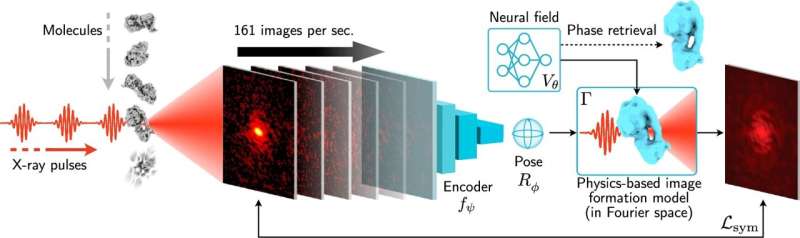
A team at SLAC National Accelerator Laboratory (LCLS) has introduced a new machine-learning algorithm called “X-Ray single particle imaging with Amortized Inference” (X-RAI) that dramatically speeds up 3D reconstructions from X-ray imaging data, tells Tech Xplore.
Standard single-particle imaging at LCLS produces millions of 2D scattering images as X-ray pulses hit samples. Then computational algorithms assemble those into a 3D structure, but that process is slow, often taking hours or days. X-RAI, by contrast, employs a bidirectional neural-network approach: it predicts orientations from 2D images and also projects 3D structures back into 2D to refine its learning.
With this method, the team was able to process up to 160 images per second in real-time. They demonstrated sharper 3D reconstructions for test particles, such as a ribosomal subunit and ATP synthase, compared with traditional methods.
One major payoff: experimental time at facilities such as LCLS is scarce and expensive. Faster reconstruction means researchers can get actionable results during the data-collection window, rather than waiting till later. Looking ahead, X-RAI could pave the way toward “movies” of biomolecules in motion, capturing not just where atoms are but how they change in real time.
For engineers and scientists working in imaging, photonics, and structural biology, this development highlights a trend: algorithms and ML models are now becoming as critical as hardware in unlocking experimental throughput and enabling new types of dynamic experiments.
