

Researchers at Japan’s Shibaura Institute of Technology have demonstrated that adaptive-focus display technology could improve user interactions in augmented reality (AR) and virtual reality (VR). Their findings suggest that dynamically adjusting focal distances can make virtual-object manipulation faster and more efficient, tells Tech Xplore.
Conventional AR and VR headsets typically display virtual objects at a fixed focal distance, regardless of their perceived depth. This creates a mismatch between eye convergence and focusing, known as the vergence-accommodation conflict (VAC). The resulting visual inconsistency can affect user comfort and interaction performance.
To address this limitation, an international research team led by Assistant Professor Xiaodan Hu developed a varifocal AR display that adjusts its focal plane according to virtual-object depth. The technology provides more natural visual cues, allowing users to interact with digital objects positioned at different distances.
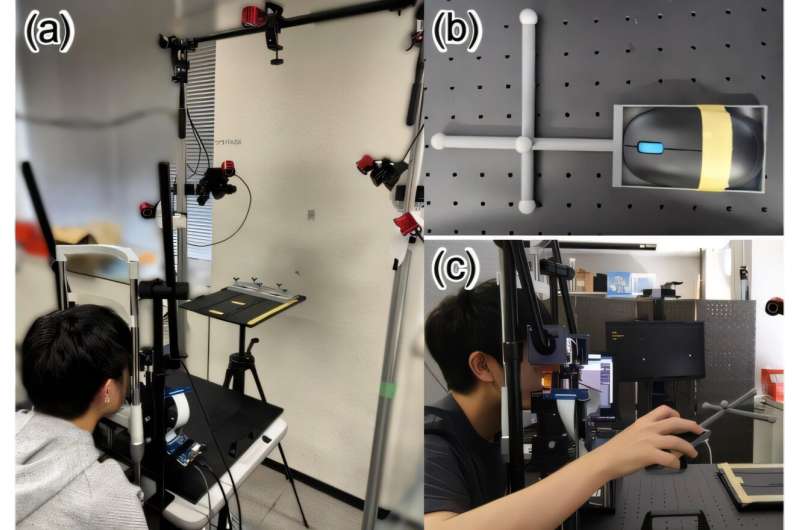
The researchers evaluated the system through experiments involving 3D pointing tasks. Participants used a tracked handheld wand to select virtual targets of varying sizes and distances. The team compared conventional fixed-focus displays with varifocal technology, measuring movement speed, accuracy, and information throughput.
The initial study involved 24 participants, followed by 12 additional participants in a second evaluation.
Results showed that varifocal displays significantly reduced movement times and increased information throughput without significantly affecting error rates. Improvements appeared particularly promising for movements involving changes in depth, although performance benefits varied among participants.
Despite these findings, the researchers acknowledged several limitations. The prototype had a restricted field of view and lacked eye-tracking capabilities. Additionally, the study did not establish whether adaptive focusing reduces long-term eyestrain.
Published in the journal Virtual Reality, the research highlights opportunities for developing personalized AR and VR systems that accommodate individual visual characteristics. Future investigations will explore factors influencing user performance and ways to improve adaptive display designs for practical applications across immersive digital environments.
