

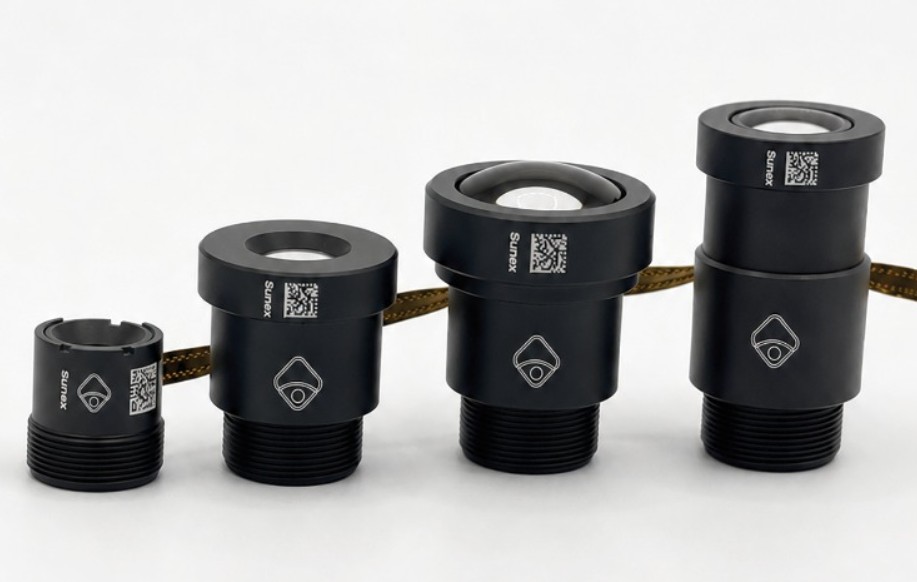
The growing adoption of artificial intelligence (AI), robotics, and autonomous systems is transforming machine vision requirements. Traditional industrial cameras operate under predictable conditions, but emerging applications demand imaging systems capable of maintaining clarity across changing distances, lighting conditions, and operational environments, tells this article from Photonics Spectra.
Advances in complementary metal-oxide-semiconductor (CMOS) sensors have enabled compact, energy-efficient imaging systems. However, increasing sensor resolution and decreasing pixel size make cameras more susceptible to optical imperfections. Even minor focusing errors can compromise AI-based object recognition, inspection, and classification accuracy.
Conventional solutions have limitations. Fixed-focus lenses restrict operating distances, smaller apertures reduce light collection, and multicamera configurations increase system complexity. Mechanical autofocus mechanisms also introduce concerns regarding durability, power consumption, and physical dimensions.
To address these challenges, poLight ASA, Sunex Inc., and Image Quality Labs have developed a collaborative framework combining adaptive focusing, precision optics, and imaging system integration.
At its core is poLight’s TLens technology, which uses piezoelectric microelectromechanical systems (MEMS) to adjust optical power without moving the primary lens assembly. The technology offers focusing response times as short as one millisecond and accommodates distances ranging from less than 10 centimeters to infinity.
However, adaptive focusing alone cannot guarantee superior imaging performance. Optical engineering must also address distortion, resolution, manufacturing consistency, and reliability.
Image Quality Labs complements these capabilities through camera development, hardware and software integration, image signal processing, performance characterization, and system validation. Coordinating these elements helps manufacturers reduce development risks and transition more efficiently from component selection to production.
The article emphasizes that effective machine vision requires engineers to consider the entire imaging pipeline rather than optimize individual components independently.
For engineers developing industrial automation, intelligent scanners, autonomous machines, and embedded vision applications, this integrated approach offers a practical direction for improving visual perception. As physical AI evolves, adaptable optical systems could become increasingly important in ensuring accurate recognition, reliable navigation, and informed automated decision-making.
