

Additive manufacturing is becoming increasingly important to space engineering, changing both the production of rocket components and the way engineers approach their design. Develop 3D explores this shift through EOS and its work in metal 3D printing for aerospace applications.
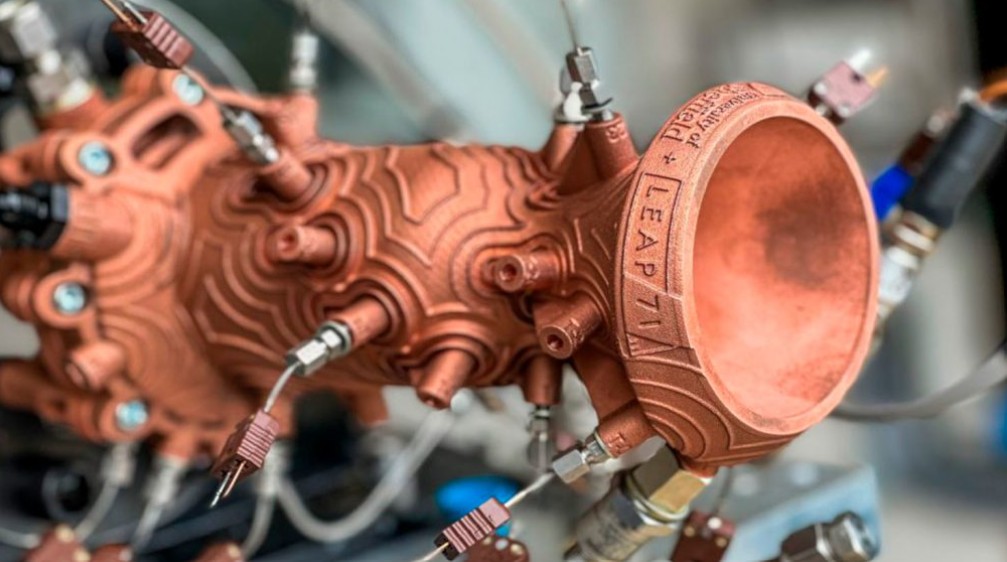
One example combines artificial intelligence with additive manufacturing. Dubai-based LEAP71, working with the University of Sheffield and Airborne Engineering, created a rocket thruster entirely through computational modeling. The component was printed on an EOS M290 without using CAD during the design process. Moving from final specifications to manufacturing took just two weeks rather than months.
Hot-fire testing showed that the unconventional design performed as expected and achieved steady-state operation. Testing can provide data that AI systems use to modify subsequent designs, potentially creating a faster, more objective development cycle.
Speed is particularly valuable in space engineering, where rapid prototyping can help companies move from an idea to testing within weeks. Additive manufacturing also offers a relatively straightforward route to scaling production. Instead of creating new tooling and production lines, manufacturers can increase capacity by adding printers, even at different locations.
EOS is also automating its printing operations. Traditionally, operators must remove completed parts and prepare machines for subsequent builds. Automating these tasks reduces downtime and allows printers to resume production after about an hour, increasing machine utilization with fewer staff members.
Qualification remains critical because space components operate under demanding conditions. EOS is working with regulatory organizations to establish standards for additive manufacturing and demonstrate that printed components meet required specifications. Better process control can also reduce post-processing requirements.
Durability provides another potential advantage. According to EOS aerospace industry manager Philipp Stich, one 3D-printed component has already survived 33 rocket launches.
The combination of AI, automation, and additive manufacturing suggests a broader transformation in aerospace engineering, enabling faster iteration, distributed production, reusable components, and design approaches that would be difficult to achieve with conventional manufacturing.
