

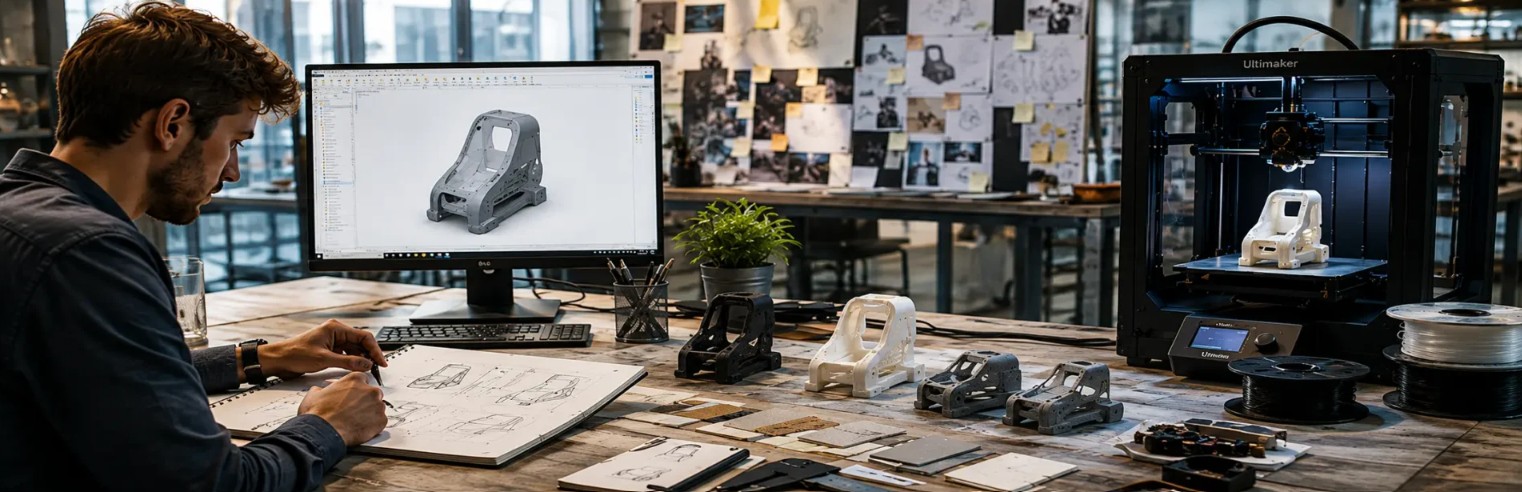
Additive manufacturing has transformed prototyping by allowing engineers to move quickly from digital designs to physical parts. Unlike conventional manufacturing processes that remove material, additive manufacturing builds components layer by layer. This approach can reduce waste while enabling complex geometries, lightweight structures, customized components, and faster design iterations, tells CADD Centre.
The workflow begins with concept development. Engineers identify the problem, intended users, functional requirements, and manufacturing constraints before creating a three-dimensional CAD model. The CAD model becomes the digital foundation for subsequent stages, defining dimensions, features, and assembly details while allowing engineers to evaluate and modify designs before committing material.
Design for Additive Manufacturing, or DfAM, takes the process further. Engineers optimize components specifically for additive production by reducing unnecessary material, creating lightweight internal structures, consolidating multiple parts, and improving printability. Material selection follows, with plastics, engineering polymers, metals, composites, ceramics, and resins offering different combinations of strength, flexibility, durability, precision, and surface quality.
Before printing, slicing software divides the CAD model into thin layers and generates machine instructions. Parameters such as layer height, printing speed, temperature, and machine movement can significantly affect build quality, material consumption, and production time. The printer then builds the component using technologies ranging from filament and resin processes to powder bed fusion.
Printed parts typically require post-processing, including support removal, cleaning, sanding, polishing, machining, or heat treatment. Engineers then test dimensional accuracy, functionality, durability, ergonomics, and overall performance.
Testing frequently reveals opportunities for improvement. Engineers modify the CAD model, print another prototype, and repeat the evaluation cycle until the design meets its requirements. This ability to iterate rapidly makes additive manufacturing valuable not simply as a production technology, but as an important tool for improving engineering decisions before full-scale manufacturing begins.
