

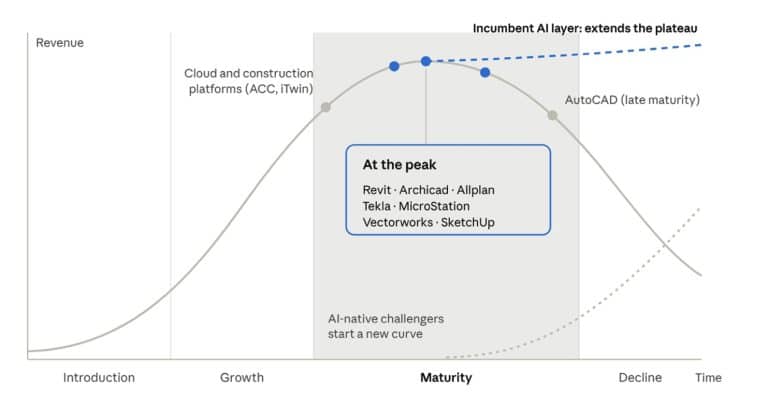
Established architecture, engineering, and construction (AEC) software vendors are approaching a critical stage in their product lifecycles. Biplab Sarkar, chief product officer of neoBIM, examines whether artificial intelligence (AI) can establish new growth opportunities for Autodesk, Nemetschek, Trimble, and Bentley or simply prolong the profitability of their mature products, tells Architosh.
Sarkar identifies several indicators of market maturity, including aging flagship applications, completed subscription transitions, pricing-driven revenue growth, and declining research and development (R&D) intensity.
Although absolute R&D expenditures have increased, several leading vendors allocate a smaller percentage of revenue to innovation than they did a decade ago. Meanwhile, acquisitions and share repurchases reflect changing capital allocation priorities.
Established computer-aided design (CAD) and building information modeling (BIM) applications continue to generate substantial cash flows, supporting investments in cloud platforms, construction technologies, and AI.
Incumbents are pursuing three principal AI strategies: embedding intelligent assistants within existing applications, connecting external AI agents through Model Context Protocol (MCP) servers, and introducing alternatives to per-seat licensing.
However, these strategies introduce potential vulnerabilities. Autonomous agents could reduce demand for individual software licenses, while third-party AI platforms could weaken established vendors’ direct relationships with customers.
AI-native competitors such as Motif, Arcol, Snaptrude, TestFit, and Augmenta are pursuing opportunities without the architectural constraints and backward compatibility requirements associated with legacy software. Nevertheless, established vendors retain significant advantages in financial resources, distribution, customer relationships, and engineering data.
For AEC professionals, this evolving competitive landscape raises important questions about future software investments, interoperability, workflow automation, and technology adoption.
Engineering firms may need to reconsider whether their existing software environments can accommodate increasingly autonomous design processes. Evaluating emerging platforms alongside established applications could help organizations anticipate changing licensing economics, reduce technological dependencies, and prepare for new collaborative workflows.
The industry’s next phase will test whether established software ecosystems can evolve without sacrificing the reliability and functionality professionals depend on.
