

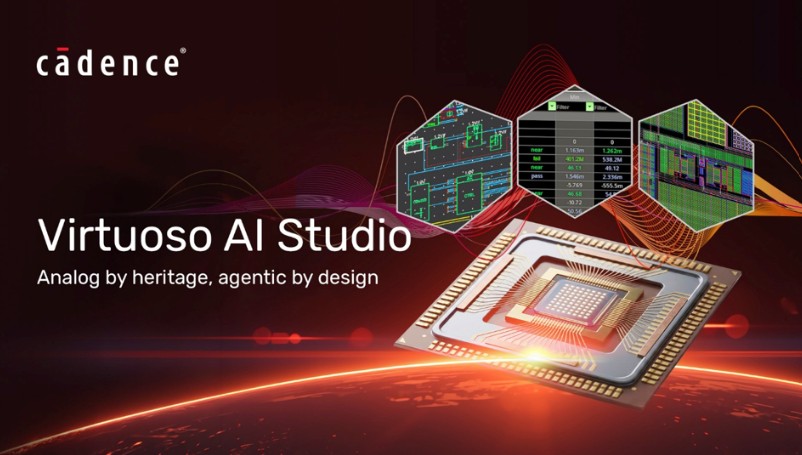
Analog and mixed-signal designers face increasing complexity as advanced process nodes introduce tighter margins, new device behavior, stricter rules, and stronger interactions among circuit design, layout, simulation, and verification. Cadence argues that agentic AI can reduce the effort surrounding these tasks, giving engineers more time for design decisions.
Virtuoso AI Studio, combined with the ViraStack AI Super Agent, embeds AI directly into the analog design environment. Engineers can use natural language to create testbenches, configure simulations, and generate Cadence SKILL code. Because the system has access to Virtuoso APIs and design context, generated scripts can be tailored to specific engineering tasks.
Technology migration is another major application. Moving analog designs between processes requires more than replacing devices because power, sizing, operating points, constraints, and layout requirements can change. ViraStack can coordinate topology mapping, device scaling, simulation, and optimization. Cadence reports 60% faster design closure in a demonstrated 6 GHz analog/RF PHY migration.
AI agents also extend into physical implementation. They can propose floorplans, generate placement and routing alternatives, identify design-rule violations, and support parasitic-aware post-layout optimization. Engineers review proposed actions and retain authority over final changes.
Domain knowledge is central to Cadence’s approach. ViraStack combines built-in skills, Virtuoso-specific information, design intent, methodology knowledge, and an IP Catalog containing hundreds of analog building blocks. This context is intended to improve accuracy and reduce hallucinations.
The AI layer operates on established Cadence simulation and verification technologies rather than replacing them. Agents determine actions, invoke appropriate EDA engines, analyze results, and coordinate subsequent steps.
For analog engineers, the shift is therefore toward delegating repetitive setup, analysis, scripting, and workflow coordination while retaining responsibility for architecture, tradeoffs, verification, and final engineering decisions.
