

Semiconductor companies can scale computing resources quickly, but experienced chip designers remain difficult to find. ChipAgents argues that agentic AI could address this imbalance by extending automation beyond individual EDA tools and allowing specialized agents to execute and coordinate larger portions of the semiconductor development process.
Complex chip projects can take about 30 months, with verification consuming substantial engineering effort. Cloud computing has already helped companies scale compute and storage while improving infrastructure flexibility and reliability. Yet these improvements do not solve the shortage of experienced IC engineers.
Generative AI introduces another layer of automation. Potential applications span design planning, RTL and testbench generation, bug triage, log analysis, scripting, verification, packaging, diagnostics, and production support. ChipAgents focuses on agents that can work across these tasks rather than remaining confined to one EDA application.
AWS provides the underlying infrastructure. Amazon Bedrock gives semiconductor teams access to different AI models for different tasks. Sensitive assets, including RTL, PDKs, and netlists, can remain within a company’s private cloud environment.
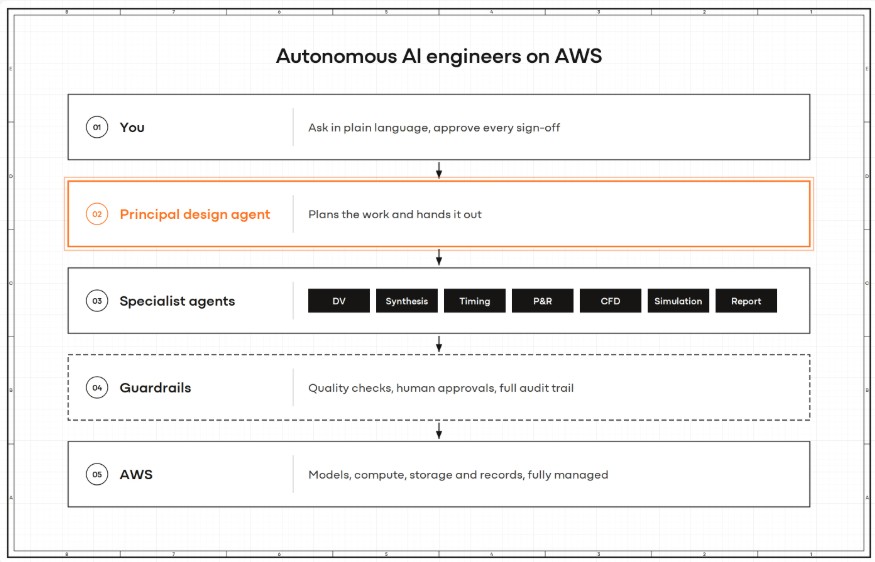
ChipAgents adds semiconductor-specific agents for workflows such as specification-to-RTL generation, test creation, simulation orchestration, and autonomous bug hunting. A principal agent could coordinate specialists responsible for verification, synthesis, timing, place-and-route, CFD, simulation, and reporting.
Autonomy, however, does not eliminate engineering oversight. The proposed architecture uses machine-verifiable quality gates for timing, routing, DRC, foundry checks, and other results. Human approval remains necessary before irreversible decisions, while execution records provide an audit trail.
AWS also proposes an AI-Driven Development Lifecycle in which teams define objectives and policies, AI agents produce plans, and engineers approve those plans before execution.
The larger shift is from scaling computing infrastructure to scaling engineering capacity. AWS and ChipAgents envision AI agents augmenting scarce semiconductor expertise while engineers retain responsibility for validation and signoff.
