

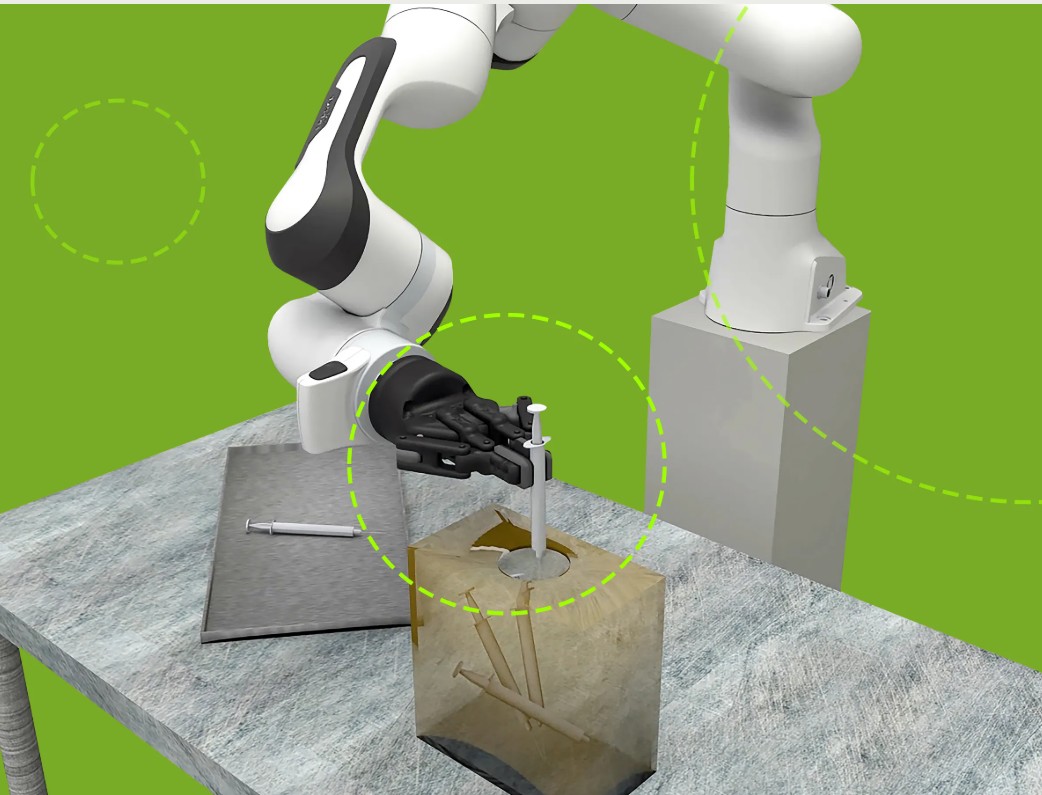
Industrial robots traditionally rely on carefully programmed instructions or machine learning models trained on extensive human demonstrations. Researchers at the University of California, Berkeley, and Nvidia are exploring a different approach called agentic robotics, which uses AI agents to generate, test, and refine robot control code, tells IEEE Spectrum.
Presented at the 2026 Conference on Robot Learning, the approach addresses a fundamental challenge in robotics: collecting sufficient training data to achieve reliable performance. Unlike large language models trained on internet-scale datasets, robots lack comparable amounts of real-world interaction data.
Agentic robotics replaces much of this data dependence with automated programming. Engineers describe tasks using natural language, and multiple AI coding agents divide them into smaller operations involving perception, object manipulation, motion planning, and execution.
For example, when instructed to pack groceries, separate agents can identify objects, control robotic grippers, and coordinate movements. The generated code is tested in simulation, where agents identify failures, modify instructions, and repeat the process until performance improves.
Researchers also use AI agents to adjust simulation parameters, including lighting, environmental conditions, and physical interactions, to better reproduce real-world scenarios.
In UC Berkeley tests, agentic robotics achieved success rates of up to 99%, matching human-engineered solutions. Comparable imitation-learning approaches achieved success rates as low as 20% on certain tasks.
The technology could significantly improve industrial automation. Nvidia reports that retasking a robot at Taiwanese manufacturer Wistron currently requires at least eight hours, whereas agentic robotics could reduce that process to one or two minutes.
However, challenges remain. Simulations cannot perfectly reproduce physical contact, and AI-generated code requires careful validation.
Researchers believe agentic robotics could initially benefit precision manufacturing, including semiconductor production, where accuracy and repeatability are essential. Its broader potential lies in combining established robotics technologies with autonomous AI coordination, making industrial robots more adaptable without relying exclusively on massive training datasets.
