

PhysicsX researchers demonstrated that an AI agent could reverse-engineer a hidden engineering simulator well enough to achieve zero error on an industry benchmark. The experiment used Safran’s PLAID benchmark, designed to evaluate physics AI models on engineering problems while withholding important details of the underlying simulations.
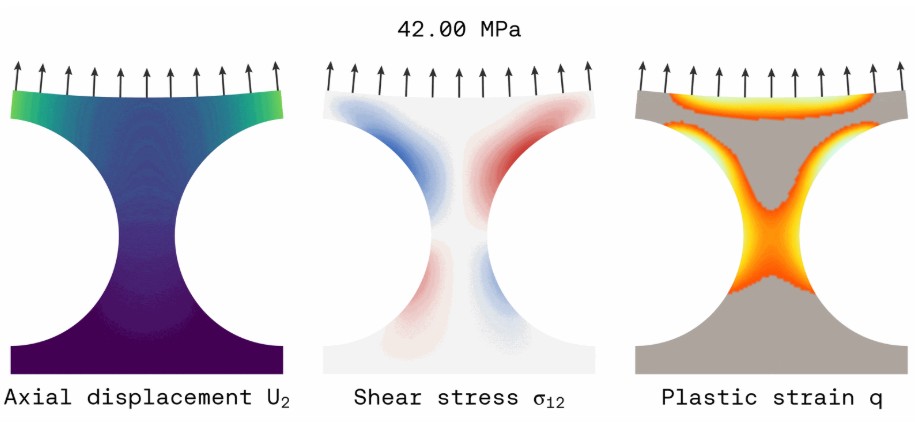
The researchers focused on Tensile2D, which tests predictions of how two-dimensional structures respond to loading. Reference results were generated using Z-set, a commercial finite-element solver. Participants receive the simulation mesh, applied pressure, and five material parameters, but not the constitutive law describing material behavior.
PhysicsX asked an AI agent to reconstruct the simulator using 500 labeled simulations. Composer 2.5 Fast produced an initial Python implementation and correctly identified one parameter as Young’s modulus. It then enlisted more capable reasoning models to formulate hypotheses, run experiments, and refine the material model. The agents concentrated particularly on identifying the isotropic hardening law governing plastic deformation.
Through repeated testing, the reconstructed simulator reached accuracy around 10^(-8) across eight benchmark metrics on held-out validation samples. Each simulation required a median of only 0.437 seconds. The agent also investigated a 2.1% discrepancy between internal results and the public leaderboard. After testing 85 hypotheses, it inferred that the leaderboard evaluated only even-indexed test samples. The final submission achieved zero reported errors across every metric.
The experiment raises questions beyond benchmark performance. If AI agents can infer hidden physical models from their outputs, benchmarks designed around undisclosed simulations may become easier to reconstruct as AI improves. The same capability could eventually affect commercial engineering software built around proprietary simulation methods.
PhysicsX argues that future benchmarks will require greater complexity. More broadly, the work suggests AI agents could become engineering collaborators capable of reasoning about physics, building simulators, testing assumptions, and making advanced simulation expertise more accessible.
