

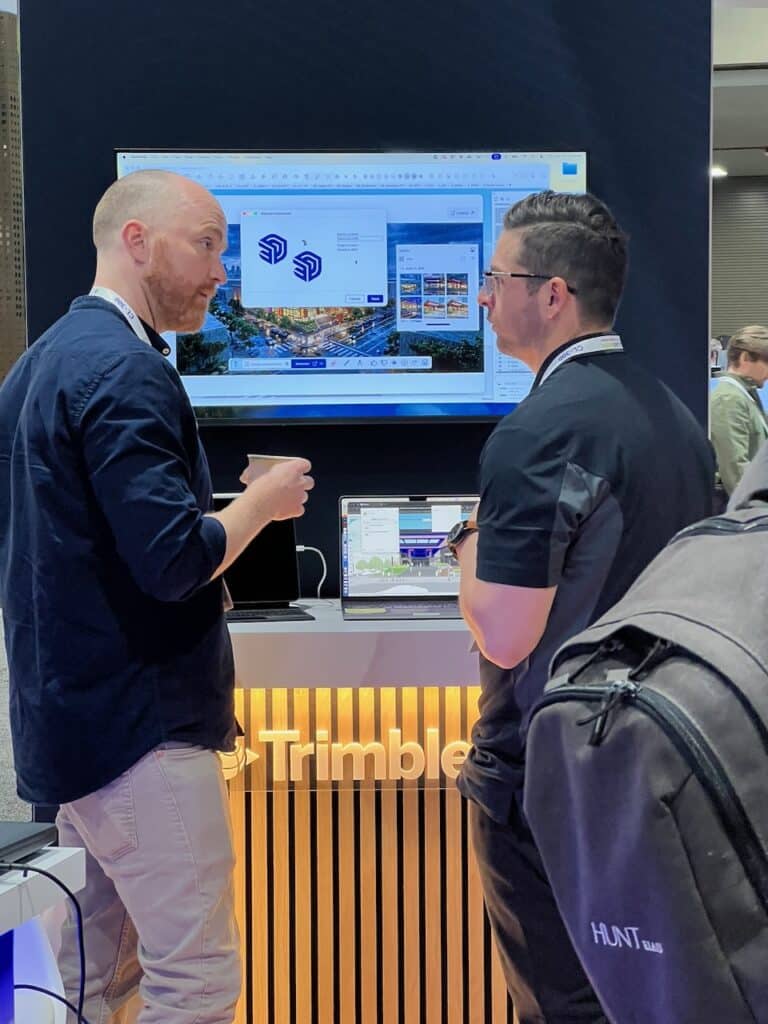
The AIA26 Conference on Architecture and Design in San Diego showcased a new stage in the evolution of digital tools for the architecture, engineering, and construction (AEC) industry. While artificial intelligence was already a prominent theme at previous events, this year’s conference highlighted the growing maturity of agentic AI and workflow automation, with software vendors demonstrating tools that move beyond information retrieval to actively performing tasks on behalf of users, tells Architosh.com.
A central theme was the emergence of Anthropic’s Model Context Protocol (MCP), an infrastructure standard often described as “USB-C for AI.” MCP enables AI systems to connect with software applications and orchestrate workflows. Rather than simply answering questions, AI can now interact directly with software, execute commands, and manage complex sequences of actions. This capability was evident in new integrations such as SketchUp’s Claude connector, which allows users to generate and edit 3D models through natural-language prompts, and Bluebeam Max, where AI can automate batch searches, highlighting, and other document-processing tasks.
The conference also highlighted a broader industry trend toward AI-driven user interfaces. Increasingly, CAD and BIM applications are incorporating chat-based assistants that translate natural-language instructions into software operations. These tools can automate repetitive processes, accelerate complex workflows, and make advanced software capabilities accessible to users who may lack specialized technical expertise.
Beyond AI, automation remained a major focus. Emerging BIM 2.0 platforms are emphasizing data-centric workflows and application programming interface (API) connectivity that allow information to move seamlessly between software systems. Arcol, for example, demonstrated bidirectional synchronization with Microsoft Excel, enabling architects, contractors, and developers to connect design data directly with project cost information.
Perhaps the most forward-looking development came from NeoBIM, a German startup building an AI-native software ecosystem from the ground up. Its buildingOS platform integrates agentic AI throughout the building lifecycle, from early-stage planning to digital twins used after construction.
Together, these developments suggest that the AEC industry is moving beyond AI-assisted workflows toward software ecosystems where intelligent agents actively participate in design, analysis, coordination, and project execution.
