

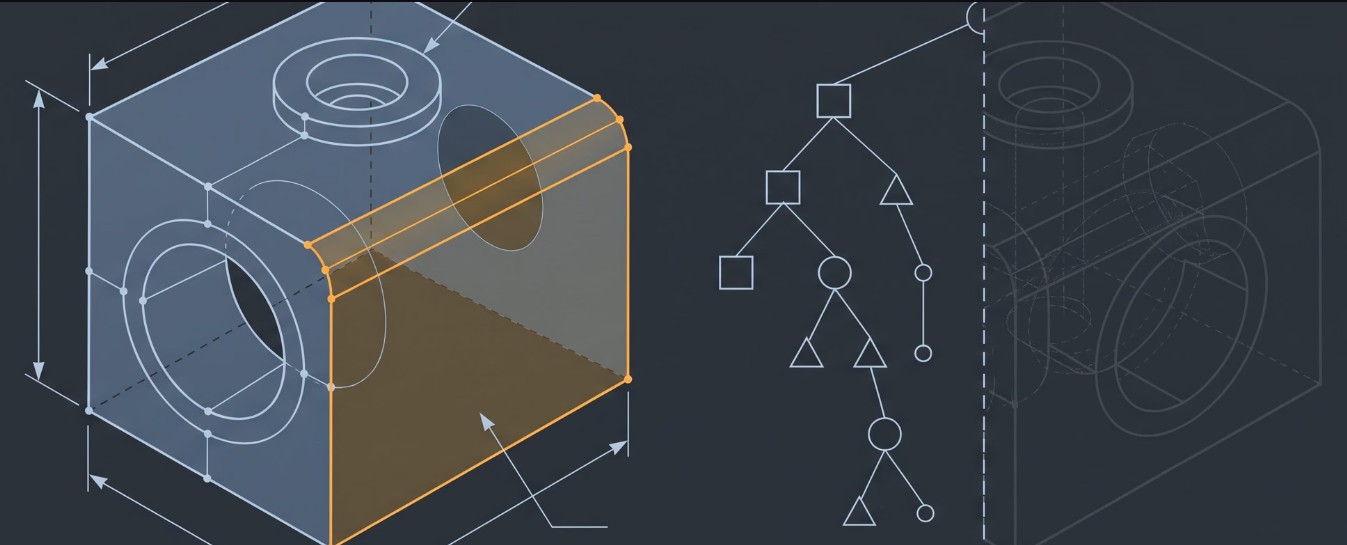
Parasolid files can give AI agents detailed information about a component’s geometry, but they do not contain the full engineering intelligence behind the design. Leo AI explains the distinction between what an agent can extract from a Parasolid file and what remains in the CAD, PDM, or PLM system.
Parasolid, the geometric modeling kernel used by many CAD systems, stores models using boundary representation, or B-rep. Its .x_t text and .x_b binary files describe bodies through faces, edges, vertices, loops, shells, surfaces, and curves. An AI agent can therefore determine face types, dimensions, connectivity, hole sizes, fillet radii, wall thicknesses, and whether geometry represents a closed solid, open sheet, or wire.
This geometric information enables practical AI applications. Agents can identify through-holes, locate small fillets, detect unclosed bodies, calculate bounding boxes, and create geometric signatures for finding similar or duplicate components. Leo recommends performing numerical geometry calculations with deterministic code rather than asking a language model to interpret raw numeric records.
Parasolid files can also carry attributes such as names, colors, layers, material tags, and identifiers. However, these attributes depend on what the originating CAD application exports, so agents cannot assume that specific metadata will always be available.
The major limitation is design intent. Parasolid stores the resulting shape, not the process that created it. Feature trees, sketches, constraints, equations, configurations, and parameters remain within the native CAD application. Manufacturing tolerances and datum information may also be absent, while revision status, approvals, permissions, and where-used information typically reside in PDM or PLM systems.
For engineering AI, the article recommends combining Parasolid geometry with drawings and PDM or PLM records. This allows an agent to move beyond recognizing shape and answer broader questions involving released parts, revisions, tolerances, and product usage.
