

Researchers at Sungkyunkwan University have developed two AI technologies designed to make autonomous systems more efficient and dependable during complex, long-horizon tasks. Led by Professor Minhae Kwon, the research addresses two persistent problems: the high computational cost of AI agents and the risk of learning unreliable behaviors from offline data, tells Tech Xplore.
The first technology, Self-improving Agent with Gated critique, or SAG, changes the way AI agents obtain feedback. Many agents repeatedly consult a more capable AI model while completing a task, increasing computing requirements and response times. SAG instead allows an agent to evaluate its uncertainty and request external feedback selectively, similar to a student seeking assistance only when necessary.
The agent also stores successful experiences and learns from them, gradually reducing its dependence on outside feedback. In complex virtual environments, SAG consumed about one-third of the computational resources required by conventional approaches. At the same time, its task success rate increased from 24.6% to 78.3%.
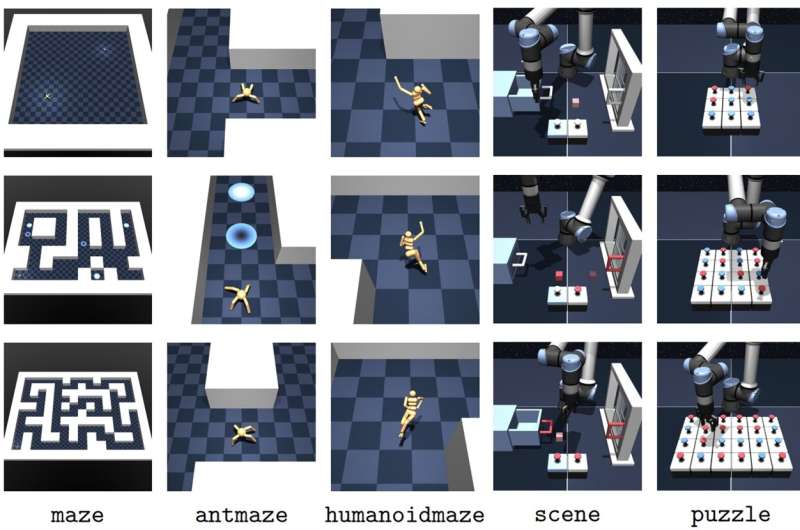
The second technology, VAN-Flow, addresses reliability in offline reinforcement learning. This is particularly important for robots and autonomous vehicles, where extensive real-world trial and error could create safety risks. Systems trained on historical data can mistakenly interpret an action that succeeded through chance as a reliable strategy.
VAN-Flow uses a mathematical approach that filters out behaviors whose success depends heavily on chance. Instead, it favors actions that perform consistently under changing conditions. The method achieved higher success rates than most existing advanced techniques across more than 40 challenging robotic-control simulation tasks.
Both studies were accepted for NeurIPS 2026. Together, they point toward autonomous AI that can use computing resources more selectively while making more dependable decisions, capabilities that could support practical deployment in robotics, autonomous driving, and industrial AI systems.
