

Additive manufacturing continues to grow, but turning 3D printing into a dependable high-volume production method requires more than faster printers. In an interview with Machine Design, HP executive François Minec identifies cost, repeatability, automation, software integration, materials, and AI-assisted design as critical factors for broader adoption.
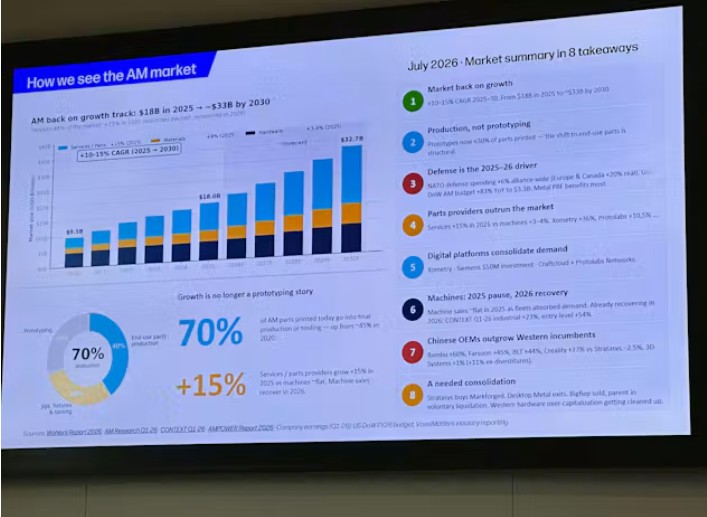
Global additive manufacturing revenue reached $24.2 billion in 2025, according to figures cited from the Wohlers Report 2026. Printing services grew faster than equipment sales, suggesting that the market is increasingly shifting from buying machines toward producing usable parts at scale.
For manufacturers, repeatability is essential. Parts produced on different machines and at different locations must maintain consistent quality across batches. Cost per part is equally important because it determines when additive manufacturing becomes competitive with injection molding and other established processes.
Integration also matters. HP wants its printers to function as connected components of broader production environments, using APIs to communicate with manufacturing execution systems and equipment for post-processing, finishing, and other operations. Medical applications illustrate the potential. Cranial helmets can now be produced from quick scans, replacing labor-intensive plaster casting with a largely digital scan-to-part workflow.
Materials can further improve economics through faster processing, powder reuse, and higher productivity. Yet Minec sees design as one of the biggest remaining barriers. Designing effectively for additive manufacturing still depends heavily on specialized human expertise.
AI could change that. Future tools could allow engineers to describe requirements directly to CAD software and ask it to redesign and optimize components for processes such as HP Multi Jet Fusion. AI can also improve process optimization, predictive maintenance, and early failure detection.
Minec argues that reducing cost per part has an outsized effect on market potential. Combined with automated design and connected production workflows, AI could make additive manufacturing practical for much larger production volumes.
