

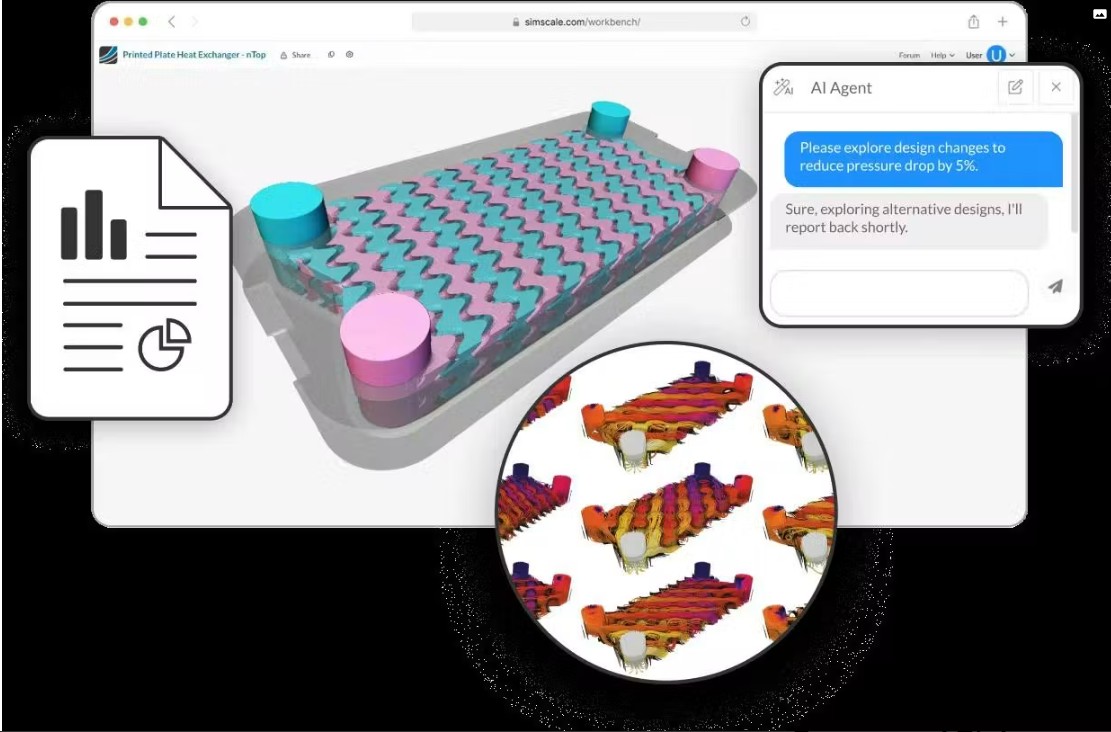
SimScale is bringing artificial intelligence and cloud computing deeper into computer-aided engineering with a browser-based platform designed for multiphysics simulation. Engineers can set up, run, analyze, and collaborate on simulations from different devices without relying on dedicated local computing infrastructure, tells Machine Design.
A central part of the platform is Engineering AI, which uses agentic workflows to coordinate the simulation process. Instead of requiring engineers to configure every step manually, the technology can automate individual tasks such as mesh generation and solver configuration. Engineering teams can also define a broader design challenge and use these workflows to coordinate hundreds of simulation variants simultaneously.
This approach allows engineers to explore a larger design space, compare possible configurations, and identify promising solutions before committing to physical prototypes or more computationally demanding analyses.
SimScale also offers Physics AI for accelerating computational fluid dynamics studies. Engineers can first run hundreds of CFD simulations in parallel through a cloud-based design of experiments. The resulting simulation data is then used to train a Physics AI model. Once trained, the model can evaluate new design variations in a fraction of the time required for conventional high-fidelity CFD. According to SimScale, predictions can remain within 5% accuracy of the full simulations.
The platform’s cloud architecture supports these AI capabilities through integration with NVIDIA PhysicsNeMo for developing physics-informed AI models and Omniverse-based technologies for digital twin environments.
Beyond AI, SimScale provides multiple simulation methods. Its solver capabilities cover CFD using OpenFOAM, lattice Boltzmann methods, and immersed boundary methods, as well as finite element analysis, thermal, electromagnetic, and multiphysics simulation.
The platform also supports smoothed particle hydrodynamics, a meshless approach for modeling dynamic fluid behavior. For targeted applications, GPU acceleration can deliver runtimes 10–20 times faster than conventional grid-based CFD.
Together, cloud computing and AI are expanding the number of designs engineers can evaluate while reducing the time required for complex simulation studies.
