

Wildfires are becoming more frequent and destructive, placing greater demands on aerial firefighting operations. A new technology developed through the Forest Shield project aims to improve the effectiveness of helicopter-based firefighting by combining real-time sensor data, digital twins, physics-based simulations, and artificial intelligence. The system is designed to help emergency crews deliver water or fire suppressant more accurately while increasing flight safety, tells Tech Xplore.
Conventional aerial firefighting often relies on pilots releasing water buckets from relatively low altitudes. Wind, heat-driven air currents, and forest conditions can significantly alter the path of falling water, reducing its effectiveness. Research has shown that even small adjustments in the timing or altitude of a drop can improve fire suppression by more than 20%. Until now, however, most efforts have focused on planning firefighting strategies before deployment rather than providing guidance during active operations.
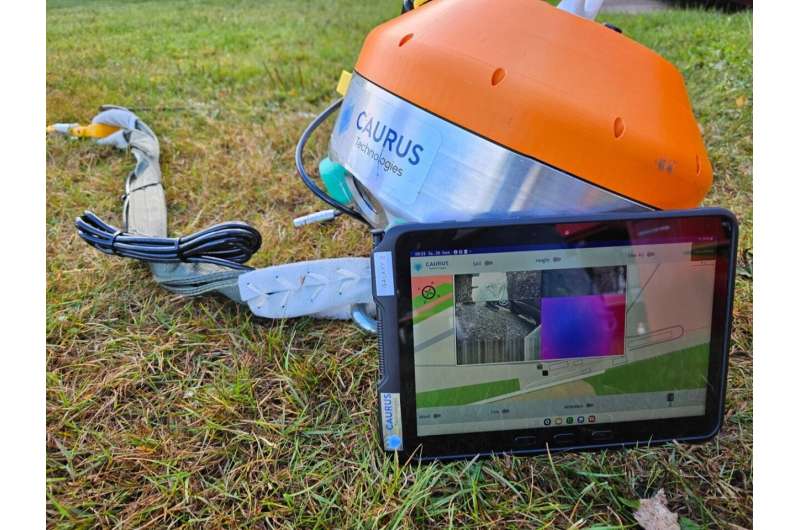
The new system addresses this limitation with a sensor platform developed by CAURUS Technologies. Mounted above the helicopter’s water bucket, the platform uses HD and infrared cameras together with position sensors to capture georeferenced images of the fire in real time. These data create a digital twin of the drop zone, allowing simulation software developed by the Fraunhofer Institute for Industrial Mathematics to predict where water droplets will land under current environmental conditions. The simulations account for factors such as wind, terrain, and forest structure, enabling response teams to evaluate each drop immediately after it occurs.
Machine learning further enhances the system by training surrogate models on thousands of simulated scenarios. These lightweight models generate rapid predictions directly at the fire scene, while data from actual water drops continuously refine future simulations. This cloud-edge feedback loop allows the prediction system to become more accurate with every deployment.
Beyond assessing fire conditions, the technology recommends the optimal release point for each water drop and measures its effectiveness in real time. By integrating sensor data, digital twins, simulation, and AI into a single decision-support platform, the project demonstrates how advanced engineering tools can make aerial firefighting more precise, safer for helicopter crews, and more effective in controlling increasingly complex wildfires.
