

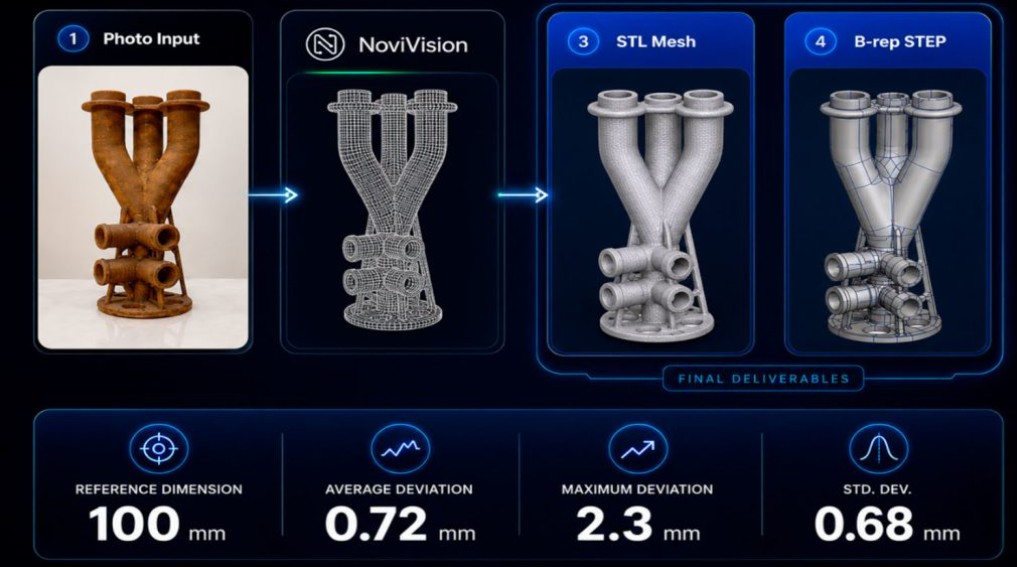
In an interview with Develop 3D, Novineer CEO Ali Tamijani discusses the company’s vision of simplifying additive manufacturing by connecting reverse engineering, simulation, and generative design into a single AI-powered workflow. Rather than treating these as separate processes, Novineer aims to help manufacturers move from a physical part to an optimized, printable design with fewer manual steps and lower costs.
The company’s software suite consists of three complementary products. NoviVision creates editable CAD models from just a few smartphone photographs, eliminating the need for expensive 3D scanners and lengthy manual reconstruction. NoviPath performs performance simulations for fused deposition modeling (FDM) parts by using the actual printing toolpaths instead of assuming the part is a uniform solid. NoviDesign completes the workflow by generating optimized, manufacturable CAD models tailored for additive manufacturing. Together, the tools support the entire process from reverse engineering to production-ready design.
Tamijani believes the greatest opportunity lies with additive manufacturing service providers that receive legacy components originally produced through CNC machining or injection molding. He illustrates this with an airline seeking to replace an aircraft seat armrest. Traditional reverse engineering requires engineers to travel with 3D scanners, inspect the part, rebuild the CAD model, perform multiple simulations, and conduct repeated physical testing. The process can take several weeks and cost tens of thousands of dollars. Novineer’s platform allows staff to capture a handful of photographs, generate a digital model, simulate its performance, and produce a quotation much more quickly, significantly reducing time and expense.
Artificial intelligence plays a targeted role throughout the workflow rather than replacing engineering judgment. AI helps reconstruct CAD geometry from photographs and accelerates simulation by simplifying complex computational meshes while preserving accuracy. Tamijani stresses that engineering principles and physics remain central to the process, with AI serving as a tool that improves efficiency instead of making design decisions. For customers in aerospace and defense, the company also offers private server deployments to meet strict security requirements.
Looking ahead, Tamijani sees AI becoming a standard component of engineering software. By reducing repetitive work, minimizing physical testing, and enabling faster design iterations, AI can make additive manufacturing more economical while allowing engineers to focus on solving complex design challenges rather than recreating existing geometry.
