

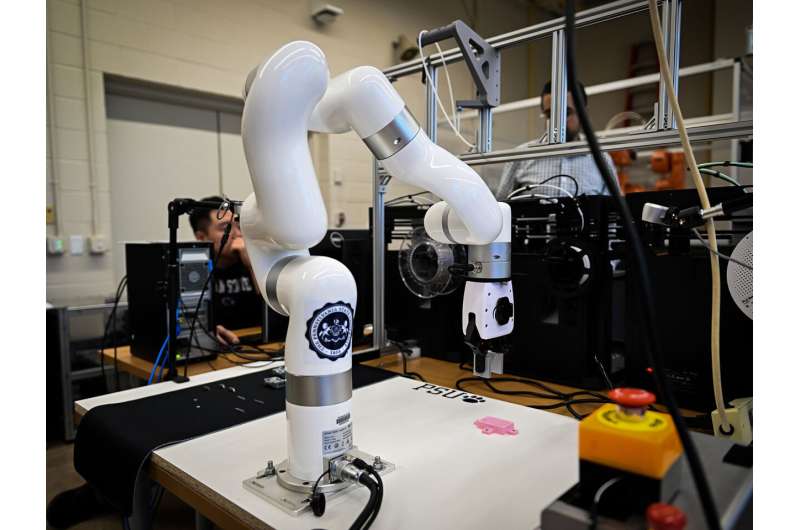
Artificial intelligence and robotics are transforming American manufacturing by improving production efficiency, workplace safety, and operational flexibility. Growing investments in advanced manufacturing are accelerating research into intelligent robots, simulation technologies, and automated production systems.
In an interview published by Tech Xplore, Ilya Kovalenko, assistant professor of mechanical engineering and industrial and manufacturing engineering at Pennsylvania State University, discusses the technological developments shaping the industry.
One major driver is the push to bring manufacturing operations back to the United States. Supply chain disruptions during the COVID-19 pandemic exposed the risks of relying heavily on overseas production. Consequently, manufacturers are investing in automation to strengthen domestic capabilities, particularly among smaller businesses struggling with labor shortages and increasing demand.
AI-powered robots can handle repetitive, hazardous, and physically demanding tasks, reducing workplace risks while improving productivity. More importantly, intelligent automation enables manufacturing systems to adjust dynamically to changing production requirements.
Kovalenko emphasizes the importance of flexible and reconfigurable production environments. AI and smart robotics can help factories respond to changing customer specifications, optimize operations, and improve resource utilization.
Emerging applications include humanoid robots, large-scale additive manufacturing, advanced semiconductor fabrication, and modernized foundry operations. These technologies could support more efficient production across multiple industrial sectors.
Workforce development remains equally important. Universities such as Penn State are preparing future engineers through hands-on training, interdisciplinary research, and practical experience with advanced manufacturing equipment.
Looking ahead, Kovalenko envisions manufacturing systems capable of adapting automatically to external conditions, including weather changes, energy availability, and evolving customer requirements. Such capabilities could reduce material waste and electricity consumption.
He also anticipates manufacturing extending beyond traditional factory environments, potentially enabling production activities during transportation.
The article highlights a shift toward intelligent, adaptable manufacturing systems where AI, robotics, and skilled workers collectively improve industrial resilience, sustainability, and competitiveness.
