

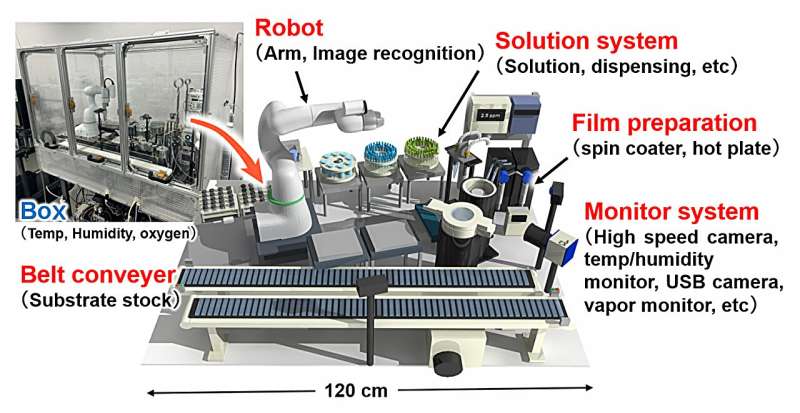
Researchers at the University of Osaka have developed an automated platform that combines robotics, high-speed optical measurements, environmental monitoring, and machine learning to improve the fabrication of perovskite solar cells. The approach could reduce the trial-and-error experimentation that has complicated efforts to produce consistent, high-performance perovskite films, tells Tech Xplore.
Perovskite solar cells rely on a thin light-absorbing layer created when a liquid solution dries and crystallizes into a solid film. Small variations in temperature, humidity, coating conditions, and other factors can alter this process, affecting the structure of the film and ultimately the cell’s efficiency. The researchers designed their automated system to observe these changes while the film is forming rather than evaluating only the finished material.
The platform coordinates automated film deposition with rapid optical imaging and environmental measurements. It can detect film color changes in less than a second and track the movement and impact of antisolvent droplets within milliseconds. These droplets play an important role in controlling crystallization during perovskite fabrication.
Machine learning is central to interpreting the large amount of experimental data collected by the system. By analyzing multiple processing variables together, the researchers can identify relationships between events occurring during film formation and the quality of the resulting material. This provides a data-driven way to determine which manufacturing parameters have the greatest effect on performance.
The researchers used these findings to optimize the antisolvent coating process. Their analysis identified a preferred range of droplet behavior, which was then applied to produce a lead-based perovskite solar cell. Under optimized conditions, the device achieved a power conversion efficiency of 24.4%.
The research demonstrates a broader role for AI and automated experimentation in materials engineering. Combining robotics, real-time measurements, and machine learning could help researchers understand complex manufacturing processes faster while improving the reproducibility and performance of emerging photovoltaic technologies.
