

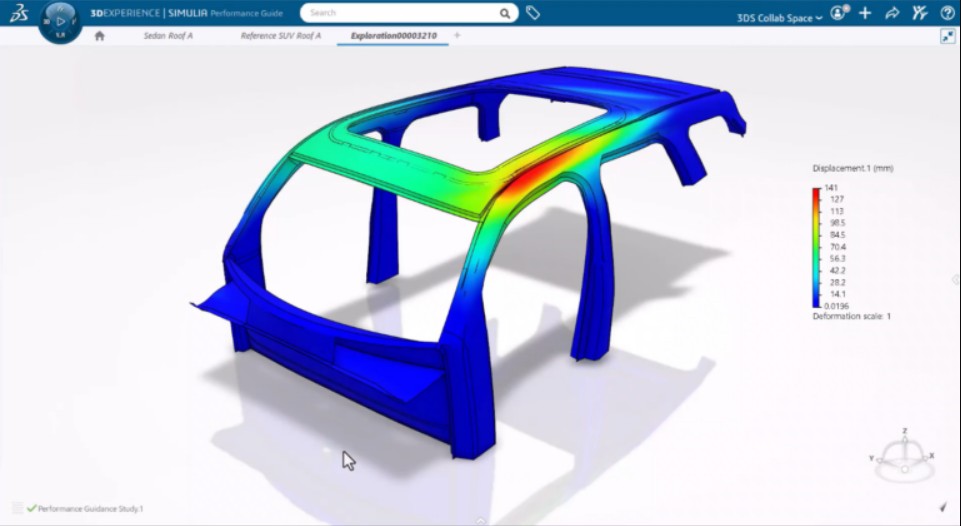
Dassault Systèmes is combining physics simulation, artificial intelligence, and virtual twins to give designers faster feedback on product performance. A virtual twin is a digital representation of a physical product or system that reproduces its real-world behavior, allowing engineers to test designs before building physical prototypes.
Simulation provides the physics foundation for these twins. SIMULIA tools can model events ranging from vehicle crashes and package drops to water penetration in electronics. However, conventional high-fidelity simulations can take hours or days and often require specialist expertise, limiting their use during rapid design iteration.
Dassault Systèmes addresses this gap through MODSIM, its approach to unified modeling and simulation. CAD geometry can feed directly into simulation, while design changes automatically update the analysis. Results can then guide design decisions without forcing teams to move repeatedly between disconnected modeling and analysis processes.
AI extends this approach by learning from simulation data generated with validated SIMULIA tools. Expert analysts run simulations across design variants and use the resulting data to train machine-learning models that represent the product’s physics behavior. Once trained, these models can estimate the performance of new variants much faster than traditional simulation, giving designers near-immediate insight into the effects of design changes.
The approach is intended to let designers explore more alternatives, predict behavior, and optimize products earlier while retaining a connection to expert-validated physics. Instead of replacing simulation, AI acts as a fast predictive layer trained on simulation results.
GPU-accelerated computing is central to making these AI-powered virtual twins practical. Dassault Systèmes is working with Nvidia on a shared industrial AI architecture that combines virtual twins with scalable AI infrastructure. The partnership supports simulation workloads, AI model training, and deployment while advancing computational algorithms. Together, simulation, MODSIM, AI, and accelerated computing are moving virtual twins toward faster, more accessible engineering decision-making.
