

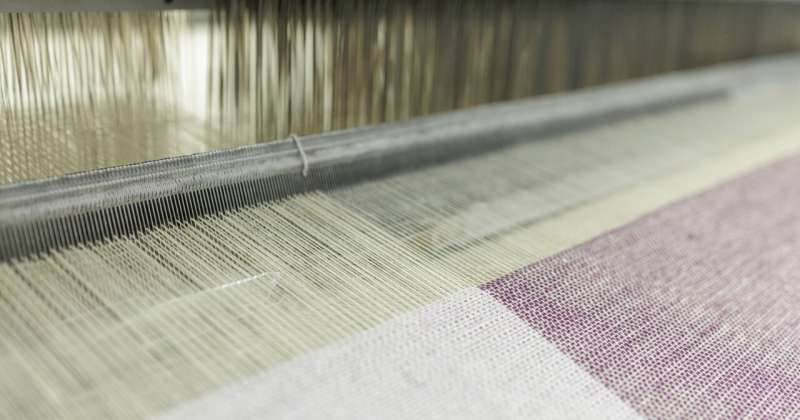
Researchers have developed an AI-assisted approach that dramatically speeds the design of woven materials for sound absorption. The method combines machine learning, symmetry analysis, and physics-based simulation to explore yarn patterns that would be impractical to evaluate individually, tells Tech Xplore.
The challenge comes from the enormous number of possible over-and-under yarn arrangements. Even a 10-by-10 weave can produce more configurations than researchers could realistically test, while a detailed acoustic simulation of a single design can require more than an hour.
An international team from École Centrale de Lyon/CNRS, Tohoku University, and RIKEN addressed the problem by first generating weave patterns that met basic manufacturing and connectivity requirements. The researchers grouped these patterns according to four repeating symmetry types, including rotational and mirror symmetry.
An AI system then arranged structurally similar patterns on a design map. Researchers performed detailed simulations on a limited selection and used those results to train a predictive model. The trained system could assess candidate patterns and guide a computer-based search in less than a minute. Independent simulations showed that predicted sound-absorption performance agreed with detailed simulation results within 5%.
The research also revealed that symmetry plays a functional role in acoustic performance. Yarn crossings influence airflow through microscopic gaps in the fabric. Some arrangements create winding airflow paths that dissipate more sound energy through friction and heat, while more open structures produce different acoustic responses. The size of a pattern’s smallest repeating unit also affects possible airflow behaviors.
The researchers emphasize that AI complements rather than replaces physics-based analysis. Their next steps include manufacturing 3D-woven prototypes for experimental testing and extending the approach to multilayer materials, larger repeating structures, and manufacturing variations. The research could support faster development of lightweight, manufacturable materials engineered specifically for broadband sound absorption.
