

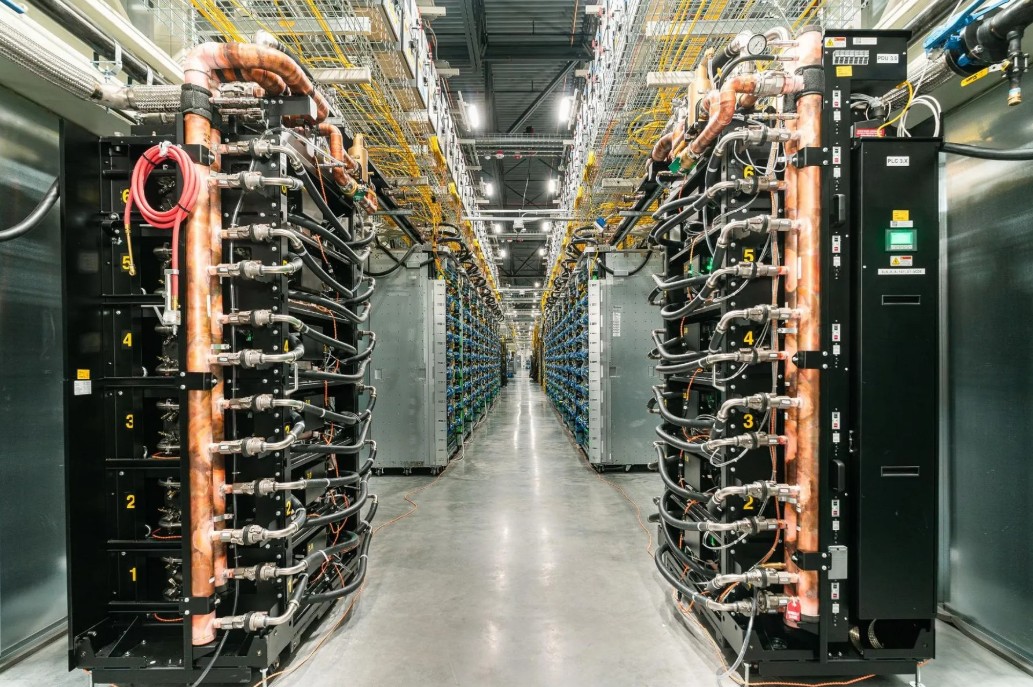
The rapid increase in AI chip power is pushing conventional air cooling toward its practical limits. Hardware FYI highlights Google’s development of liquid cooling for high-performance computing, tracing its progression from early experiments to more than 1 gigawatt of deployed liquid-cooled computing capacity.
The shift becomes clear when comparing power densities. Passively cooled devices such as smartphones and tablets generally consume 5–10 watts, while actively cooled laptops operate around 15–35 watts. Modern high-performance computing processors, however, can exceed 1,000 watts. Removing that much heat efficiently requires cooling methods capable of operating beyond the limits of traditional air-based systems.
Google uses direct-to-chip liquid cooling for its TPU infrastructure. A coolant distribution unit sends liquid through a rack manifold to individual servers. Sealed cold plates mounted directly on processors absorb heat. The warmed coolant then returns to the distribution unit, where a heat exchanger transfers the thermal energy to the building’s water system. Importantly, the internal coolant and facility water remain separate.
The article describes liquid cooling as a progression based on how much computing equipment is placed in contact with liquid. Direct-to-chip cooling represents the first phase. A second approach circulates dielectric coolant across groups of electronic components inside a server chassis. More aggressive designs can immerse entire racks, while the most expansive concept places the data center itself in a cooling environment, as demonstrated by Microsoft’s Project Natick.
These approaches involve different maintenance and infrastructure requirements, and the more extensive immersion concepts remain at varying stages of development. Google’s experience, however, provides evidence that liquid cooling can operate reliably at scale. Its liquid-cooled fleet has reportedly maintained 99.999% uptime since 2020, demonstrating why liquid cooling is becoming increasingly important as AI hardware grows more power-intensive
